Systems Thinking for Business Owners: Why Fixing One Problem Can Create Another
One of the hardest lessons I've learned in business is that solving the problem in front of you doesn't necessarily make the business better.
Sometimes it makes things worse.
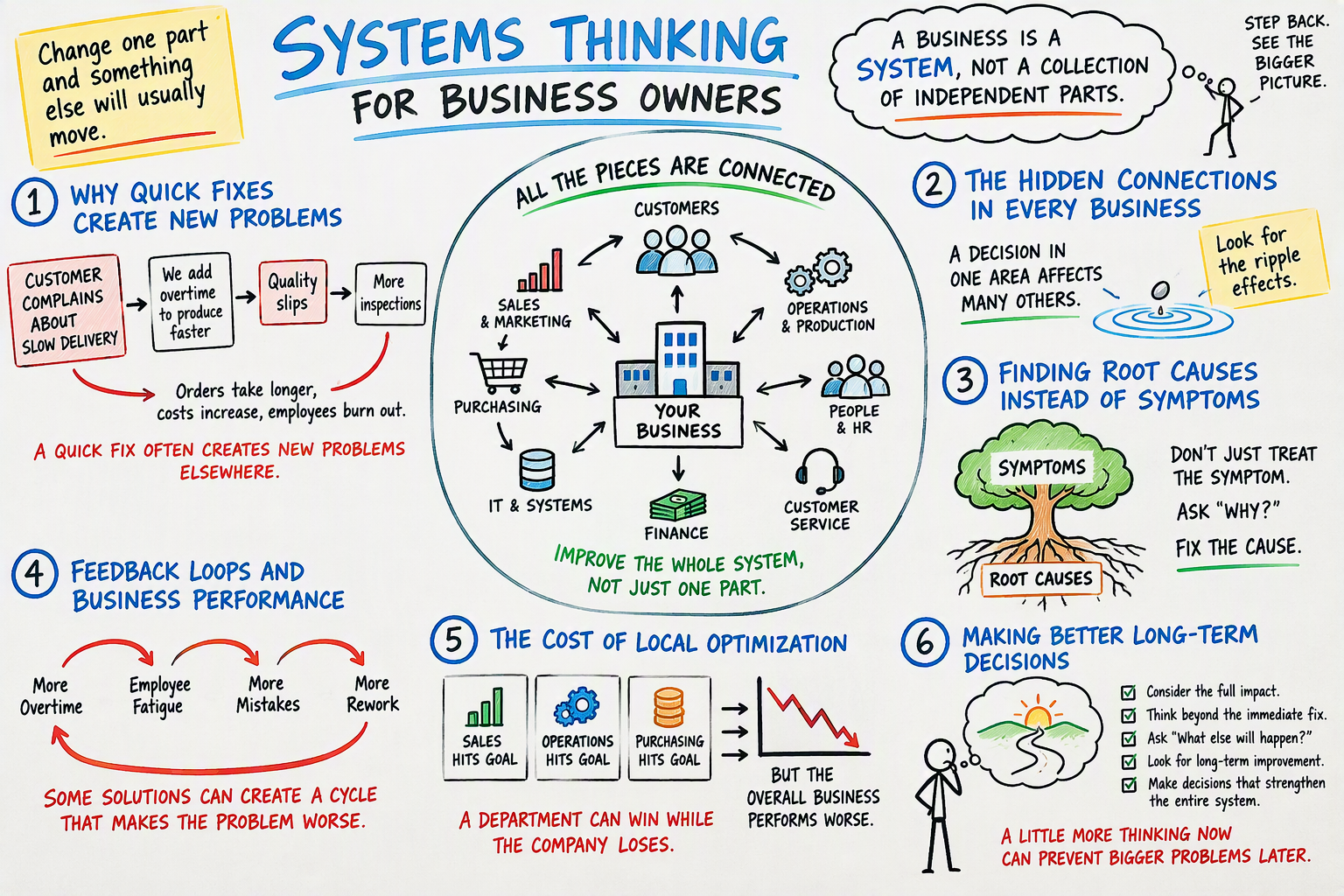
A customer complains about slow delivery, so we push production to move faster.
Production improves its output, but quality starts slipping.
We add more inspections to improve quality, but now orders take longer to ship.
We add overtime to catch up, but labor costs increase and employees start burning out.
Eventually, we're sitting in a meeting trying to understand why profitability is down when everyone has been working harder than ever.
Nobody made an obviously bad decision.
In fact, each decision might have made perfect sense when viewed by itself.
The problem is that a business doesn't operate as a collection of independent departments. It operates as a system.
That distinction matters.
Throughout my career, particularly working in operations, IT, ERP implementations, and cross-functional projects, I've seen how easy it is to optimize one piece of an organization while unintentionally creating problems somewhere else.
That is why I believe systems thinking is one of the most valuable skills a business owner can develop.
Systems thinking asks us to step back from the individual problem and look at how the pieces interact.
Instead of asking, "How do we fix this?"
We start asking, "What else will happen if we fix it this way?"
That can lead to very different decisions.
Why Quick Fixes Often Create New Problems
Most businesses are under pressure to solve problems quickly.
A customer is unhappy. Sales are declining. Costs are increasing. Employees are overwhelmed. Orders are late.
We naturally want to act.
Sometimes immediate action is necessary.
The problem comes when the temporary fix becomes the permanent solution.
Consider a business that is consistently behind on customer orders.
The obvious solution might be overtime.
For a temporary spike in demand, that might be completely reasonable.
But if overtime becomes the normal way the company meets customer commitments, overtime probably isn't solving the underlying problem. It may actually be hiding it.
Maybe scheduling is poor.
Maybe equipment downtime is excessive.
Maybe purchasing isn't getting materials soon enough.
Maybe sales is promising unrealistic delivery dates.
Maybe there is a bottleneck in one part of the operation.
Maybe the company simply doesn't have enough capacity.
Until we understand the system, we're treating the symptom.
Every month the company successfully catches up through overtime makes it a little easier to avoid confronting the real problem.
The Hidden Connections Inside a Business
One of the biggest mistakes leaders can make is viewing departments independently.
Sales has its goals.
Operations has its goals.
Purchasing has its goals.
Finance has its goals.
Customer service has its goals.
IT has its goals.
But the customer doesn't experience departments.
The customer experiences the result of all of them working together.
Imagine that purchasing is measured primarily on reducing material costs.
A buyer finds a less expensive supplier and saves the company money.
That's good, right?
Perhaps.
What happens if the new supplier has longer lead times?
Now purchasing needs to order further in advance.
Inventory may increase.
Production planning becomes more difficult.
Expedited shipments may increase.
Customer delivery performance could suffer.
The least expensive component may not produce the lowest total cost to the business.
This is where systems thinking changes the conversation.
Instead of asking whether purchasing reduced its costs, we ask whether the change improved the performance of the overall organization.
Those are very different questions.
Find the Cause, Not Just the Symptom
Business problems tend to announce themselves through symptoms:
- Late orders
- Customer complaints
- High turnover
- Excess inventory
- Low productivity
- Poor quality
- Declining margins
The danger is assuming that the symptom tells us where the problem lives.
If orders are shipping late, it looks like a shipping problem.
But what if they're late because production didn't finish them on time?
Then it looks like a production problem.
What if production was late because materials weren't available?
Now we have a purchasing problem.
What if purchasing didn't know materials were needed because sales changed the order and the information didn't flow correctly through the system?
Suddenly, our shipping problem has almost nothing to do with shipping.
This is why I am a big believer in asking "why" before asking "who."
"Who made the mistake?" usually leads us toward blame.
"Why did the system allow this to happen?" leads us toward improvement.
Feedback Loops Matter
Businesses are filled with feedback loops, even when we don't recognize them.
Imagine a company that falls behind and begins requiring substantial overtime.
Employees become tired.
Mistakes increase.
Those mistakes create rework.
Rework consumes additional capacity.
The additional workload creates even more overtime.
Now the solution that was supposed to increase capacity is contributing to the problem that created the need for additional capacity.
That's a feedback loop.
There can be positive loops as well.
Better training can lead to fewer errors.
Fewer errors reduce rework.
Less rework gives employees more time to improve processes.
Better processes make training easier, and productivity improves further.
The important point isn't the terminology.
It's recognizing that actions inside a business rarely have only one effect.
The Cost of Optimizing Individual Departments
This is one of the areas where I believe traditional management practices can work against us.
We frequently set goals by department and then wonder why departments don't work together.
Sales needs to maximize revenue.
Operations needs to maximize efficiency.
Purchasing needs to minimize material cost.
Finance needs to control spending.
Inventory needs to be reduced.
Customer service needs orders delivered immediately.
Individually, every objective sounds reasonable.
Together, they may conflict.
Sales could increase revenue by accepting highly customized orders, while those same orders destroy production efficiency.
Operations could maximize machine utilization by producing large batches, while doing so increases inventory.
Purchasing could reduce unit costs by buying larger quantities, while finance is trying to reduce cash tied up in inventory.
Everyone can hit their numbers while the business performs worse.
That's the danger of local optimization.
A department can win while the company loses.
Making Better Long-Term Decisions
Systems thinking doesn't mean we stop making quick decisions.
It means we become more conscious of their consequences.
Before making a significant change, consider asking:
- What problem are we actually trying to solve?
- What evidence tells us this is the root cause?
- Who else in the organization will be affected by this decision?
- What behavior will this decision encourage?
- Could improving this metric damage another part of the business?
- Will this decision make the overall system better, or just one part of it?
Those questions take a little longer to answer.
But sometimes slowing down for an hour can keep an organization from spending six months fixing the unintended consequences of a quick decision.
Step Back and Look at the Whole Business
As businesses grow, systems become increasingly difficult to see.
More employees become involved. More software gets added. More procedures develop. More measurements appear. Departments become specialized.
Leaders can gradually lose sight of how everything connects.
That's when troubleshooting becomes particularly difficult.
We start fixing sales problems with sales solutions and production problems with production solutions when the real issue may be somewhere in between.
Sometimes the best thing a leader can do is step back.
Follow an order from the initial customer conversation through delivery and payment.
Follow information from one department to another.
Watch what happens when an employee encounters an exception.
Look at where people maintain spreadsheets outside the primary system.
Ask employees where they spend time working around a process instead of working through it.
Those places often tell us more about the health of the organization than another dashboard ever will.
Systems thinking is ultimately about recognizing one simple truth:
Your business is not a collection of departments, employees, software applications, and processes. It is a network of relationships between all of them.
Change one part, and something else will usually move.
Great leadership isn't just about fixing problems.
It's about understanding the system well enough to solve problems without creating the next ones.
Sometimes the biggest improvement we can make starts with stepping back far enough to finally see the whole picture.