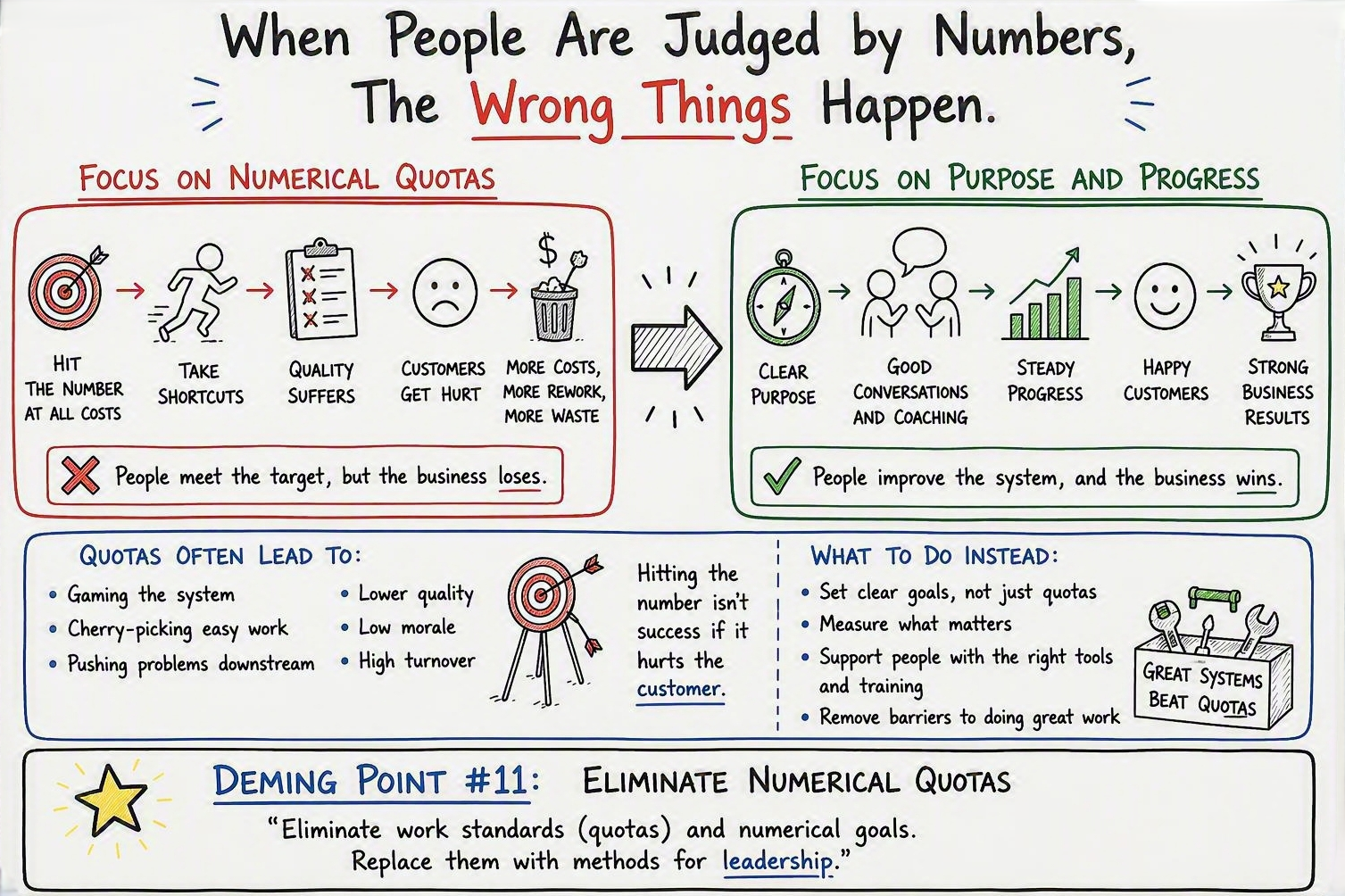
Deming Point #11: Replace Quotas With Leadership
If you've spent any time in business, you've probably seen goals like:
- Make 100 sales calls per week
- Produce 500 units per day
- Close 20 tickets per shift
- Achieve 95% utilization
- Hit this month's KPI at all costs
On the surface, these goals seem reasonable.
After all, if we measure performance, performance should improve, right?
Not necessarily.
This is the focus of Deming's Point #11, where he challenged organizations to eliminate work quotas and management by numbers and instead substitute leadership.
Deming believed numerical targets often create unintended consequences because they encourage people to focus on hitting the number rather than improving the system that produces the result.
For small businesses, this lesson is incredibly important.
When Good Metrics Create Bad Behavior
Metrics aren't inherently bad.
In fact, good leaders need data.
The problem occurs when a metric becomes the goal instead of a tool for understanding performance.
Consider a customer service team.
If leadership says:
"Close 50 tickets per day."
What happens?
Employees may:
- Rush customer interactions
- Close tickets prematurely
- Avoid complex issues
- Focus on quantity over quality
The quota gets achieved.
The customer experience suffers.
Deming consistently warned that organizations often create incentives that make the numbers look better while making the system worse.
Small Businesses Are Especially Vulnerable
Small businesses often rely heavily on metrics because they're easy to track:
- Revenue
- Calls made
- Quotes sent
- Units produced
- Jobs completed
The danger occurs when leaders focus exclusively on outputs while ignoring the factors that create those outputs.
Imagine a machine shop trying to increase production.
A quota says:
"Produce more parts."
Leadership says:
"Why aren't we hitting the number?"
A systems-focused leader asks:
"What's preventing us from hitting the number?"
That's a completely different conversation.
A Real-World Example: Google
Google's Project Aristotle set out to discover what made teams successful.
Researchers studied 180 teams and more than 250 variables, expecting to find that the highest-performing teams simply had the best people or strongest individual performers.
They were wrong.
The most important factor wasn't a performance quota or aggressive targets.
It was psychological safety, along with team dynamics that enabled collaboration, learning, and problem-solving. Google's research found that how people worked together was more important than simply measuring output.
This aligns closely with Deming's philosophy:
Great results come from great systems, not from pressuring people with arbitrary numbers.
What Deming Was Really Teaching
Deming wasn't saying:
"Ignore data."
He was saying:
"Don't confuse measurements with improvement."
A dashboard doesn't improve quality.
A KPI doesn't solve a process problem.
A quota doesn't eliminate waste.
Leadership improves systems.
Improved systems improve results.
The numbers follow.
Five Practical Actions for Small Business Leaders
1. Examine Your Metrics
Ask:
What behavior is this metric encouraging?
Every measurement influences behavior.
Make sure it's encouraging the right behavior.
2. Measure Quality Alongside Quantity
Instead of focusing only on:
- Sales calls
- Units produced
- Jobs completed
Also track:
- Customer satisfaction
- First-pass quality
- Rework rates
- Complaints
- Referrals
Balanced metrics create better decisions.
3. Investigate Before Judging
When a target is missed, avoid immediately asking:
"Who failed?"
Ask:
"What happened in the system?"
Most recurring problems originate in processes rather than individuals.
4. Focus on Trends, Not Snapshots
One bad week rarely tells the whole story.
Look for patterns.
Understand variation.
Improve the process rather than reacting to every fluctuation.
5. Develop Problem Solvers
The best organizations don't just produce results.
They produce people who can improve results.
Teach employees how to:
- Identify waste
- Analyze root causes
- Suggest improvements
- Solve problems
That's far more valuable than simply telling people to hit a target.
What This Means for Growth
As businesses grow, leaders often respond by creating:
- More metrics
- More scorecards
- More reports
- More dashboards
The question is:
Are those measurements helping you understand the system, or are they distracting you from improving it?
Deming understood that sustainable growth comes from creating better systems, better processes, and better leadership.
The organizations that win long-term are usually not the ones obsessed with numbers.
They're the ones obsessed with improvement.
Final Thought
Numbers matter.
Data matters.
Measurement matters.
But metrics are not the destination.
They're feedback.
Deming's Point #11 reminds us that leadership isn't about forcing people to hit bigger numbers.
It's about creating an environment where better numbers become the natural result of better systems.
What metric in your organization is driving the wrong behavior today?