Deming Point #12: Remove Barriers That Rob People of Pride of Workmanship
One of the most overlooked drivers of business performance is something that rarely appears on a financial statement:
People want to do good work.
Most employees don't come to work looking for shortcuts, mistakes, or ways to disappoint customers.
They want to succeed.
They want to contribute.
They want to feel proud of what they produce.
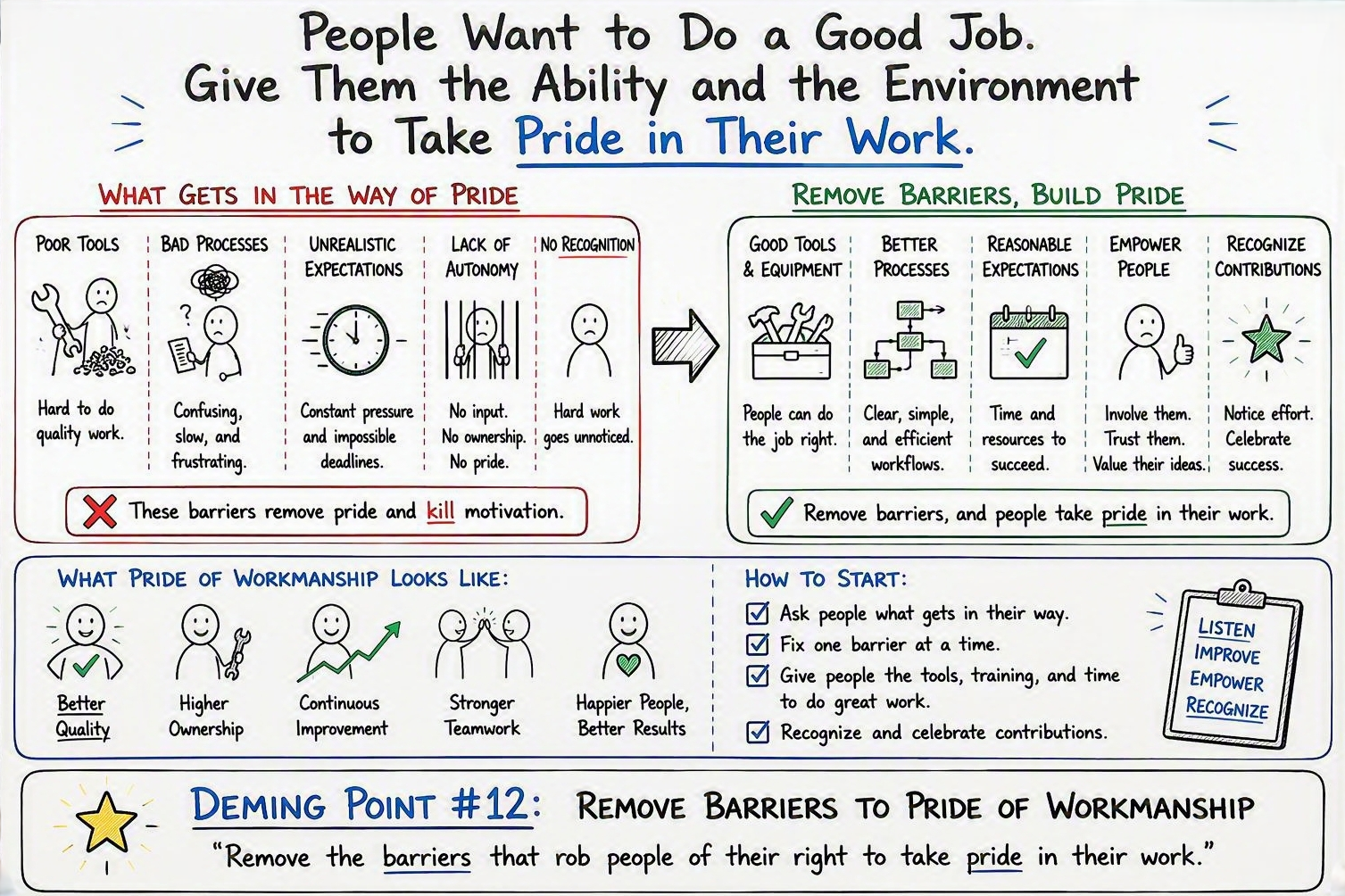
That's exactly what Deming addressed in Point #12: Remove barriers that rob people of pride of workmanship.
Deming believed that management's responsibility is to create an environment where people can take pride in their work rather than constantly fighting poor systems, bad processes, and unnecessary obstacles.
For small businesses, this point can have a profound impact.
Why Pride Matters
When people are proud of their work, they tend to:
- ✅ Pay more attention to quality
- ✅ Take ownership of problems
- ✅ Care about customers
- ✅ Look for improvements
- ✅ Stay engaged longer
The opposite is also true.
When employees feel powerless, ignored, or forced to work around broken systems, they often become frustrated and disengaged.
Not because they don't care.
Because they care and can't do their best work.
What Robs People of Pride?
Many barriers are unintentionally created by leadership.
Examples include:
- Poor equipment
- Outdated software
- Confusing procedures
- Excessive bureaucracy
- Lack of authority to solve customer issues
- Constant rework
- Unrealistic expectations
- Having to fix the same problems repeatedly
Over time, employees begin to feel like they are fighting the system rather than serving customers.
Deming repeatedly emphasized that most performance issues originate in the system, not the individual.
Why This Matters Even More in Small Businesses
Small businesses often operate with limited resources.
As a result, leaders sometimes tolerate workarounds for years.
You may hear:
"We've always done it that way."
Or:
"It's not ideal, but it works."
The problem is that employees experience those inefficiencies every day.
A five-minute frustration repeated dozens of times per day becomes a significant source of disengagement.
Small businesses don't always have the largest budgets.
But they often have the greatest ability to quickly eliminate obstacles.
A Real-World Example: Southwest Airlines
Southwest Airlines has long been recognized for empowering employees and creating a culture where people are trusted to serve customers and solve problems.
The company consistently invests in employee development, operational simplicity, and a people-focused culture. This approach has contributed to strong employee engagement, customer loyalty, and long-term business success.
Employees are encouraged to use judgment, support customers, and contribute ideas rather than simply follow scripts.
One reason Southwest became known for exceptional service isn't just training.
It's that employees are given the ability to do meaningful work without unnecessary barriers.
This aligns closely with Deming's philosophy.
People perform better when the system helps them succeed.
How Leaders Accidentally Destroy Pride
Many leaders unintentionally create barriers through good intentions.
Excessive Approval Processes
An employee sees a customer issue.
The solution is obvious.
But four approvals are required.
The customer waits.
The employee feels powerless.
Ignoring Employee Ideas
An employee suggests an improvement.
Nothing happens.
The suggestion disappears.
Eventually, suggestions stop coming.
Poor Tools
Employees are expected to do great work with outdated software, unreliable equipment, or inefficient processes.
The result?
Frustration instead of pride.
Five Practical Actions for Small Business Leaders
1. Ask Employees One Simple Question
Ask:
"What's the most frustrating part of your job?"
The answers often reveal barriers leaders never see.
2. Eliminate One Frustration Every Month
You don't need a major transformation project.
Pick one recurring pain point and fix it.
Small improvements build momentum.
3. Involve Employees in Process Improvements
The people closest to the work usually understand the problems best.
Invite them into the solution process.
4. Give Appropriate Authority
People are more engaged when they can solve problems.
Look for opportunities to reduce unnecessary approvals and increase ownership.
5. Recognize Great Work
Recognition reinforces pride.
When people do excellent work, acknowledge it publicly and specifically.
Not generic praise.
Specific examples.
What This Means for Growth
Many organizations focus heavily on customer satisfaction.
That's important.
But customer satisfaction is often the result of employee satisfaction.
Employees who are proud of their work:
- Produce higher quality
- Deliver better service
- Contribute more ideas
- Stay with the company longer
Deming understood that organizations perform better when people are able to find joy and pride in their work.
Final Thought
One of the most valuable questions leaders can ask is:
"What is getting in the way of my employees doing great work?"
The answers may reveal opportunities far more impactful than the next KPI, dashboard, or strategic initiative.
Deming's Point #12 reminds us that great organizations aren't built by demanding excellence.
They're built by removing the obstacles that prevent excellence from happening.
What is one barrier in your organization that, if eliminated, would immediately make it easier for people to do their best work?