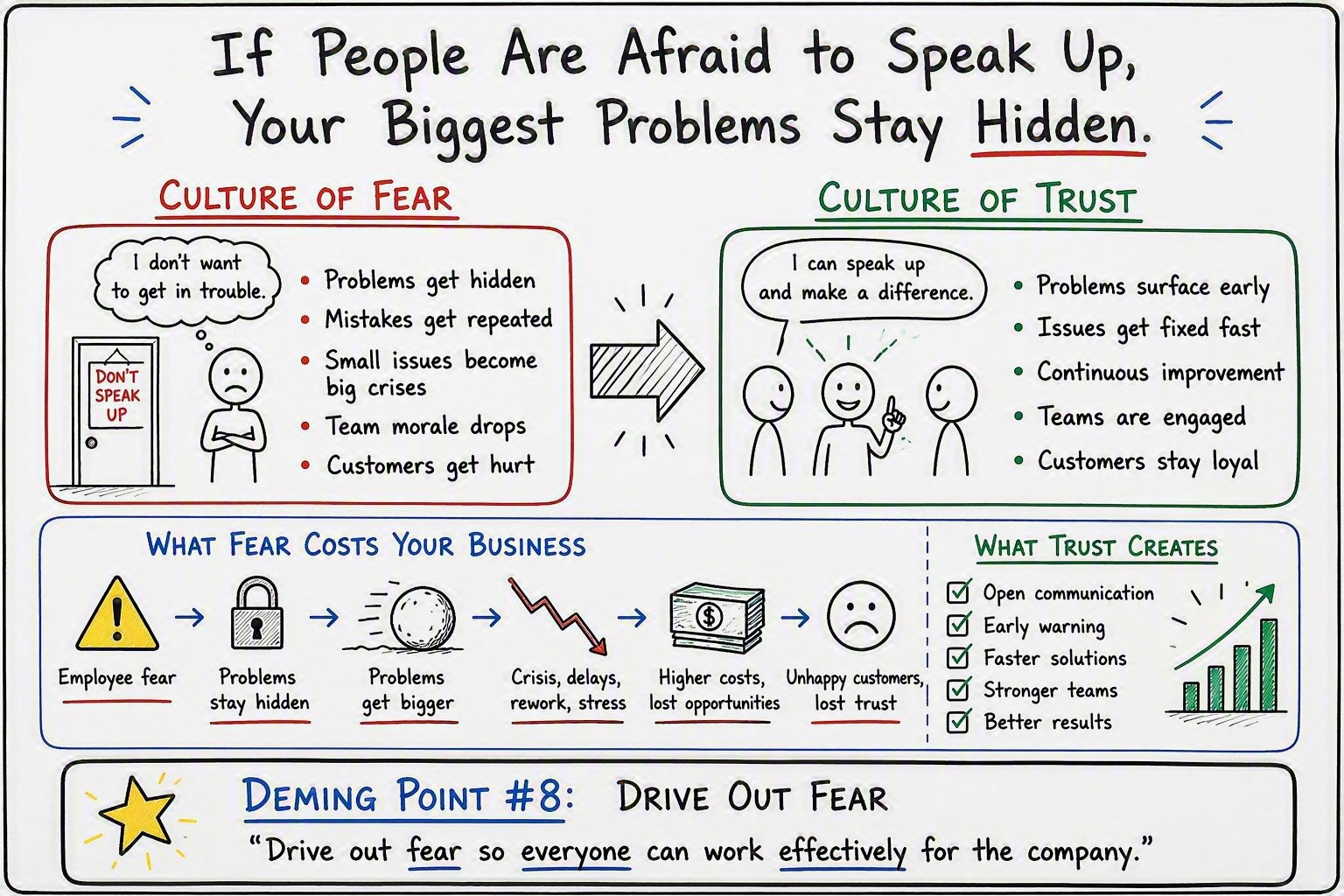
Drive Out Fear: Why Your Biggest Business Problems Stay Hidden
One of the most damaging problems in a business is also one of the hardest to see.
It's not poor quality.
It's not low productivity.
It's not even poor communication.
It's fear.
- Fear of speaking up
- Fear of making mistakes
- Fear of questioning a decision
- Fear of bringing bad news to leadership
- Edwards Deming believed fear was so destructive that he made it one of his 14 Points for Management:
"Drive out fear, so that everyone may work effectively for the company."
Many people assume this only applies to large corporations.
In my experience, it may be even more important in small businesses.
Fear Is More Expensive Than Most Leaders Realize
When employees are afraid, they rarely stop talking completely.
Instead, they stop saying the things leaders most need to hear.
They don't report problems.
They don't share concerns.
They don't challenge bad decisions.
They don't suggest improvements.
They simply keep their heads down and hope someone else deals with it.
Deming warned that fear leads to distorted information, poor decision-making, and reduced performance.
"Where there is fear you do not get honest figures."
The Cost
Problems remain hidden until customers discover them.
What starts as a small issue becomes an expensive crisis because the warning signs never reach leadership.
The Hidden Iceberg
Most business problems are like icebergs.
What Leadership Sees
- Customer complaints
- Shipping errors
- Missed deadlines
- Production issues
What Leadership Doesn't See
- Employees noticed the issue weeks earlier
- Nobody felt comfortable raising it
- Previous suggestions were ignored
- People feared being blamed
The visible problem is often only the tip of the iceberg.
The real issue is underneath.
A Real-World Example: Google's Project Aristotle
One of the most influential workplace studies in recent years was Google's Project Aristotle.
Google spent two years studying 180 teams and evaluating hundreds of factors to determine what separated high-performing teams from average ones.
Researchers found that the single most important factor wasn't intelligence, experience, resources, or team composition.
It was psychological safety.
In simple terms, people needed to feel safe enough to:
- Ask questions
- Admit mistakes
- Offer ideas
- Raise concerns
- Challenge assumptions
Google discovered that teams perform better when people can speak openly without fear of embarrassment, punishment, or humiliation.
That's essentially Deming Point #8 in action.
The lesson for small businesses is powerful:
If employees don't feel safe speaking honestly, your organization loses access to valuable information.
Fear Creates Expensive Silence
Many leaders never intentionally create fear.
It develops unintentionally through comments such as:
- "Who messed this up?"
- "We've talked about this before."
- "That's not your job."
- "Just do what you're told."
Over time, employees learn a lesson:
It's safer to stay quiet.
And when people stay quiet, improvement stops.
Signs Fear May Exist in Your Organization
Consider whether any of these sound familiar:
- ❌ Meetings where only a few people speak
- ❌ Employees rarely challenge decisions
- ❌ Problems are discovered late
- ❌ Mistakes are hidden
- ❌ Suggestions are uncommon
- ❌ Everyone agrees too quickly
These are often signs that employees don't feel comfortable speaking openly.
Five Practical Actions Small Business Leaders Can Take
1. Thank People for Bringing Problems Forward
Even when the news is bad.
Reward honesty before the problem becomes expensive.
2. Focus on Systems Before People
When something goes wrong, ask:
"What in our process allowed this to happen?"
Before asking:
"Who made the mistake?"
Deming consistently emphasized improving systems instead of blaming individuals.
3. Admit Your Own Mistakes
Leaders set the tone.
When employees see leaders acknowledge mistakes, they become more willing to do the same.
4. Ask More Questions
Google's research found that effective teams create environments where questions are welcomed.
Try asking:
- What concerns do you have?
- What are we missing?
- Where do you see risks?
- What would you improve?
5. Act on Feedback
Nothing destroys trust faster than asking for input and