Leadership vs. Management: Deming's Point #7 and the Role of Leaders in Business Growth
Many organizations have managers.
Far fewer have leaders.
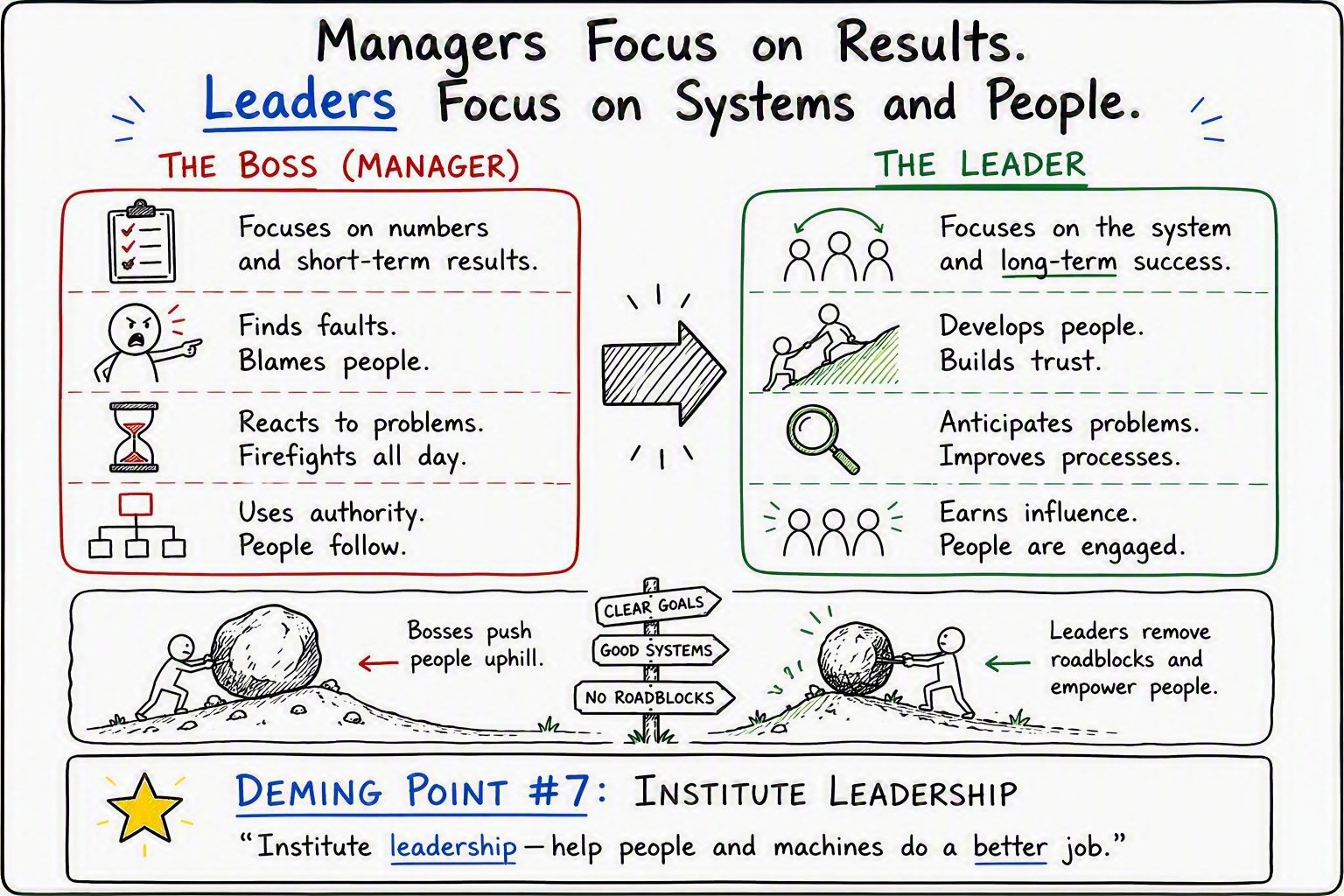
That distinction is at the heart of Deming's Point #7: Institute Leadership.
"The aim of supervision should be to help people and machines and gadgets do a better job."
Deming believed the role of leadership was not simply to measure performance, enforce rules, or hit targets.
Leadership exists to help people succeed.
For small business owners, this point can completely change how you think about managing a team.
Management vs. Leadership
Many of us grew up learning management that sounds something like this:
- Watch performance
- Correct mistakes
- Monitor productivity
- Hold people accountable
None of these are inherently bad.
But Deming argued they're incomplete.
Leadership is not about standing over employees and checking their work.
Leadership is about improving the system so employees can perform better.
A manager asks:
"Why aren't people performing?"
A leader asks:
"What obstacles are preventing people from performing?"
That shift changes everything.
The Small Business Leadership Trap
In many small businesses, owners become the answer to every question.
Every decision.
Every problem.
Every customer complaint.
Every approval.
As a result:
- ❌ Employees become dependent
- ❌ Decision-making slows down
- ❌ The owner becomes a bottleneck
- ❌ Growth becomes difficult
Deming would likely argue that this is not a people problem.
It's a leadership system problem.
Great leaders build people.
They don't build dependence.
A Real-World Example: The Ritz-Carlton
One reason The Ritz-Carlton has become known for exceptional service is its commitment to developing leaders and empowering employees.
The organization invests heavily in leadership development, coaching, training, and employee empowerment. Rather than relying solely on supervision, leaders are expected to create a culture where employees are equipped and trusted to deliver exceptional customer experiences.
The company recognizes that customer experience is driven by employee experience.
Employees who are supported, trained, and trusted perform better.
As a result, Ritz-Carlton has built a reputation for service excellence that extends across locations and over decades.
Most small businesses don't need a luxury hotel budget to apply this lesson.
They simply need leaders who view their role as helping people succeed.
What Good Leadership Looks Like
Leadership means:
- ✅ Removing obstacles
- ✅ Providing training
- ✅ Clarifying expectations
- ✅ Improving processes
- ✅ Coaching rather than controlling
- ✅ Helping employees solve problems
When an employee struggles, effective leaders look at:
- The training
- The process
- The tools
- The expectations
- The support system
Before they look at the individual.
Five Practical Actions for Small Business Leaders
1. Ask Employees What's Slowing Them Down
Instead of asking:
"How are you doing?"
Try asking:
"What's making your job harder than it needs to be?"
You'll often uncover improvement opportunities immediately.
2. Spend Time Removing Obstacles
Every week identify:
- A frustrating process
- A recurring issue
- A bottleneck
Then work to eliminate it.
Leadership creates better conditions for success.
3. Coach More, Direct Less
When someone comes with a problem, avoid immediately giving the answer.
Ask:
"What options do you see?"
Developing thinking is often more valuable than providing solutions.
4. Measure Improvement, Not Just Output
Most organizations track:
- Sales
- Revenue
- Production
Also consider tracking:
- Process improvements
- Training completed
- Problems solved
- Employee suggestions implemented
These are indicators of a healthy system.
5. Develop Future Leaders
One of the best tests of leadership is this:
"Can the business perform well when I'm not there?"
Strong leaders create more leaders.
Weak leaders create dependence.
Leadership Creates Scale
Many businesses hit growth ceilings because leadership doesn't evolve.
The owner continues making every decision.
Managers continue solving every problem.
Employees continue waiting for direction.
Eventually the organization stalls.
Leadership creates leverage.
When people are capable, confident, and empowered, the organization can grow far beyond the capacity of any one individual.
Final Thought
Deming's Point #7 reminds us that leadership isn't about authority.
It's about service.
The purpose of leadership is not to make people work harder.
The purpose of leadership is to help people do their best work.
When employees succeed, customers benefit.
When customers benefit, the business grows.
That's the power of leadership.
Reflection Question
What's the biggest obstacle your employees face today that leadership could help remove?