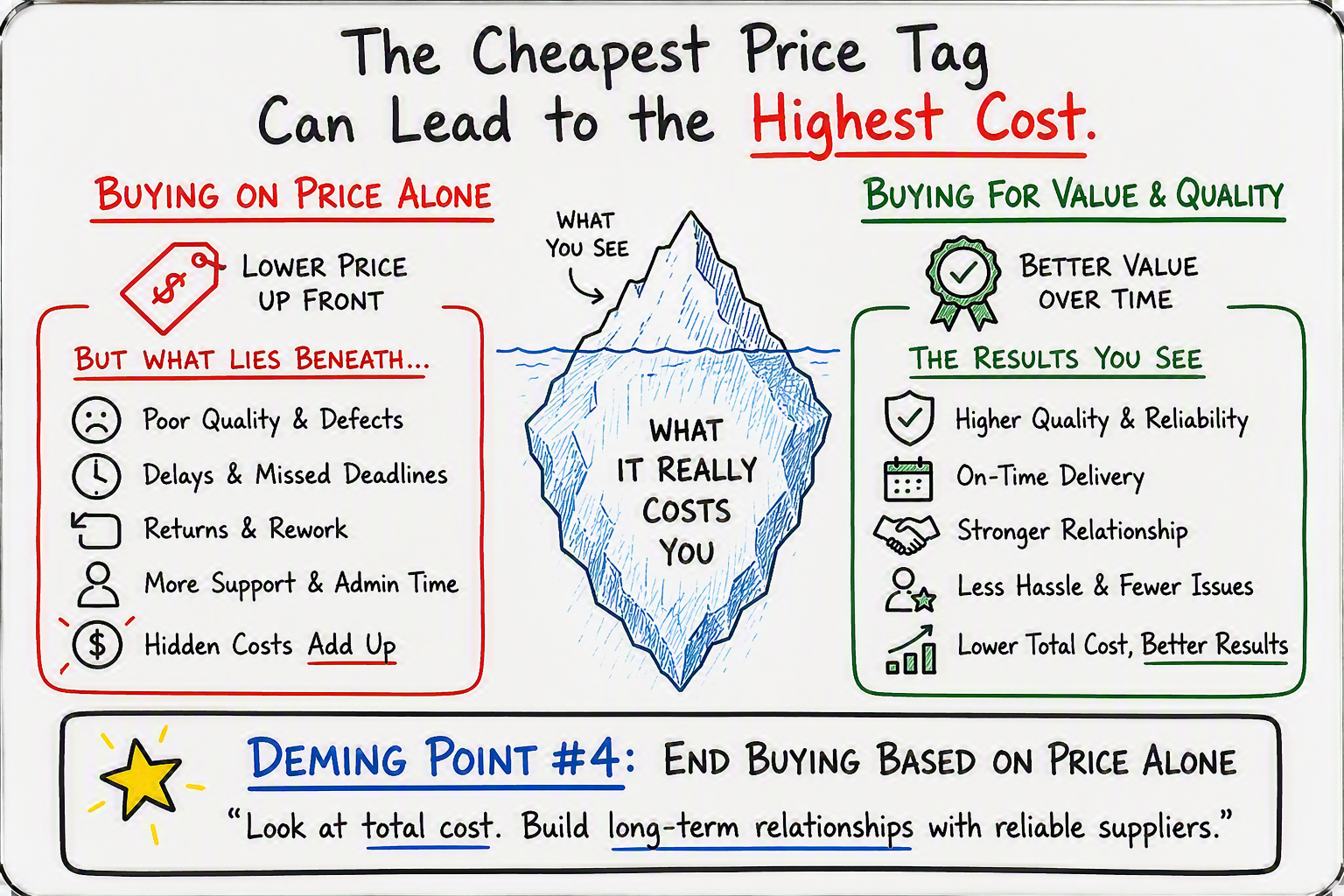
Why the Lowest Price Can Cost More: Deming’s Point #4 for Small Business Success
When budgets get tight, it's tempting to make purchasing decisions based on one factor:
Price.
The lower the quote, the better the deal... right?
Not necessarily.
This is one of the reasons Deming included Point #4 in his famous 14 Points for Management:
"End the practice of awarding business on the basis of price tag alone. Instead, minimize total cost."
At first glance, this may sound like advice for large manufacturers managing complex supply chains.
In reality, it may be even more important for small businesses.
Why?
Because small businesses have fewer resources to absorb the hidden costs of poor decisions.
One bad vendor, one unreliable supplier, one low-cost software platform, or one poorly chosen contractor can create months of headaches.
The Cheapest Option Is Often the Most Expensive
Most purchasing decisions have two costs:
The Visible Cost
- Purchase price
- Subscription fee
- Labor rate
- Material cost
The Hidden Costs
- Delays
- Rework
- Defects
- Lost productivity
- Customer dissatisfaction
- Administration time
- Missed opportunities
Many business owners only see the first category.
Deming wanted leaders to think about the second.
The question shouldn't be:
"What's the cheapest option?"
The question should be:
"Which option creates the lowest total cost over time?"
A Real-World Example: Costco
Costco has built long-term relationships with suppliers and focuses heavily on quality, consistency, and operational efficiency rather than simply chasing the lowest possible purchase price.
The company is known for maintaining a relatively limited number of SKUs and developing strong supplier partnerships that help ensure quality and reliability over time. This approach has contributed to strong customer loyalty, operational efficiency, and long-term growth.
The lesson for small businesses is powerful:
Costco doesn't win because it buys the cheapest products.
Costco wins because it creates a reliable system that consistently delivers value to customers.
Small businesses can do the same.
How This Shows Up in Small Businesses
Consider a machine shop purchasing raw materials.
Supplier A is 5% cheaper.
Supplier B offers:
- More consistent quality
- Better lead times
- Fewer defects
- Better communication
Supplier A may save money on paper.
Supplier B may save money in reality.
The same principle applies to:
- Software vendors
- Contractors
- Professional services
- Equipment purchases
- Shipping providers
- Marketing partners
- Employees
The lowest price rarely tells the whole story.
Five Practical Actions for Small Business Leaders
1. Calculate Total Cost
When evaluating vendors, include:
- Purchase cost
- Defects
- Returns
- Downtime
- Administrative effort
- Rework
Many organizations discover the "cheapest" option isn't actually the least expensive.
2. Measure Vendor Performance
Track:
- On-time delivery
- Quality issues
- Responsiveness
- Reliability
- Customer service
What gets measured gets managed.
3. Build Long-Term Relationships
Deming advocated moving toward loyalty and trust with suppliers rather than constantly switching providers based solely on price.
Strong relationships often lead to:
- Better service
- Better communication
- Better problem solving
- Better long-term economics
4. Stop Re-Bidding Everything
Some organizations create instability by constantly looking for the next cheaper option.
Sometimes the best decision is strengthening an existing partnership that is already working.
5. Ask One Extra Question
Before every major purchase, ask:
"How much will this decision cost us if it doesn't work?"
That question often changes the conversation.
What This Means for Growth
One of the biggest challenges small businesses face is inconsistency:
- Inconsistent suppliers
- Inconsistent quality
- Inconsistent delivery
- Inconsistent customer experiences
Deming understood that building a great organization requires reducing variation and improving reliability throughout the system.
Vendor relationships are a key part of that system.
The goal isn't to spend more money.
The goal is to get more value.
Final Thought
Almost every business leader has a story about the "great deal" that ended up costing far more than expected.
Deming's Point #4 reminds us that price is important.
But price is only one part of the equation.
The organizations that succeed over the long term focus on total cost, quality, reliability, and relationships.
Sometimes spending slightly more today saves a tremendous amount tomorrow.
Reflection Question
What's one purchasing decision your organization made where the lowest price turned out to be the most expensive option?