One of the most common mistakes I see in organizations is also one of the most logical.
We find something that could be better, so we improve it.
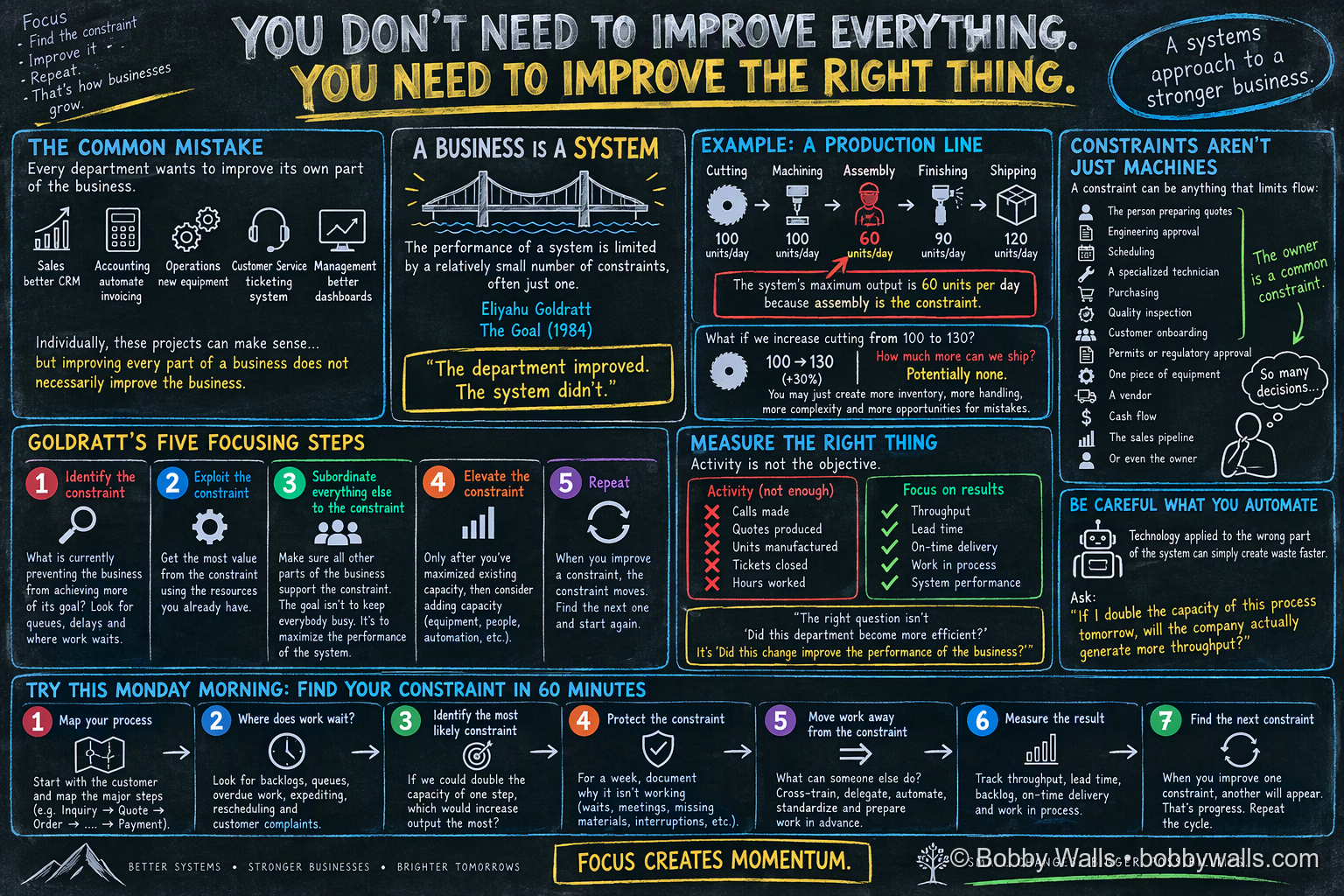
Sales wants a better CRM. Accounting wants to automate invoicing. Operations wants new equipment. Customer service wants a ticketing system. Management wants better dashboards. Everyone has projects designed to make their part of the organization more efficient.
Individually, almost every project can make sense.
But there is a problem.
Improving every part of a business does not necessarily improve the business.
Sometimes it actually makes things worse.
That is one of the most important lessons from Eliyahu Goldratt's Theory of Constraints.
Goldratt popularized the concept through his 1984 business novel The Goal. The basic idea is surprisingly simple:
The performance of a system is limited by a relatively small number of constraints, often just one.
If you want to improve the performance of the entire organization, your first job is not to improve everything.
Your first job is to find the constraint.
Then focus your improvement efforts there.
Think About Your Business as a System
Imagine a manufacturing company with five operations:
Cutting → Machining → Assembly → Finishing → Shipping
Suppose their capacities are:
- Cutting: 100 units per day
- Machining: 100 units per day
- Assembly: 60 units per day
- Finishing: 90 units per day
- Shipping: 120 units per day
What is the maximum output of this system?
It is not 100.
It is not 120.
It is approximately 60 units per day, because assembly is the constraint.
Now imagine management approves a project that increases cutting capacity from 100 to 130 units per day.
Cutting just became 30% more productive.
How much more product can the company ship?
Potentially none.
The additional output simply piles up in front of assembly. The company may actually create more work in process, more inventory, more handling, more scheduling complexity, and more opportunities for damage or mistakes.
The department improved.
The system did not.
This is the management problem Goldratt was trying to solve.
Constraints Are Not Just Machines
When people hear "bottleneck," they often picture a machine with work stacked up in front of it.
Sometimes that is exactly what the constraint is.
I have worked in manufacturing environments where a particular machine, production operation, or skilled function effectively determined how much the entire organization could produce. Keeping that resource working on the right jobs was far more important than maximizing utilization everywhere else.
But constraints are not always on the production floor.
In a small business, the constraint might be:
- The person preparing quotes
- Engineering approval
- Scheduling
- A specialized technician
- Purchasing
- Quality inspection
- Customer onboarding
- A permit or regulatory approval
- One piece of equipment
- A vendor
- Cash flow
- The sales pipeline
- Or even the owner
That last one is especially common.
I have seen businesses where virtually every significant decision eventually reached the owner's desk:
- Purchase approval
- Hiring approval
- Pricing decisions
- Customer exceptions
- Scheduling questions
- Contract approval
- Problem escalation
The company might have 20, 50, or 100 employees, but the actual capacity of the organization is partly controlled by one person's ability to make decisions.
The owner has become the constraint.
Hiring another salesperson will not solve that problem. A new ERP system will not necessarily solve it either.
The business has to address the actual constraint.
Goldratt's Five Focusing Steps
The Theory of Constraints provides a practical method for doing this. Goldratt's approach is commonly summarized as five focusing steps.
1. Identify the Constraint
Ask:
What is currently preventing this business from achieving more of its goal?
Look for queues. Where does work wait? Where are people constantly expediting? What resource is always behind? What person is everyone waiting for? Where do orders stall? What causes missed delivery dates? Where does customer demand consistently exceed capacity?
Do not assume you know.
Go look.
In manufacturing, you might literally walk the production floor and see where work accumulates.
In an office, look at timestamps. If customer inquiries are answered within two hours but quotes take six days, something in the quoting process deserves attention. If quotes go out quickly but signed contracts sit for three weeks waiting for implementation, sales is not your immediate constraint.
2. Exploit the Constraint
The word "exploit" sounds harsh, but the idea is simply to get the most possible value from the constraint using the resources you already have.
Suppose a specialized technician is your constraint. Look at everything that person does:
- Are they spending an hour each morning checking email?
- Are they entering data someone else could enter?
- Are they waiting for materials?
- Are they attending meetings that are not necessary?
- Are they fixing problems that could have been caught upstream?
- Are they searching for tools or documentation?
If that technician represents the capacity limit of your entire operation, an hour of lost productive time can affect the throughput of the entire system.
That changes how you think about the technician's work.
Protect Your Bottleneck
Years ago, working in manufacturing environments taught me something I have carried into other parts of my career:
Not all downtime has the same economic impact.
If a non-constrained operation stops briefly and has excess capacity available later, the organization may be able to recover.
If the constraint stops, however, the entire system may lose output that cannot easily be recovered.
That means you should treat your constraint differently.
Imagine a $50 component is needed to keep your constraint operating. Someone might delay purchasing it because they want to save a few dollars by combining orders.
That could be completely rational from the purchasing department's perspective.
It could also cost the company thousands of dollars in lost throughput.
Local efficiency and system performance are not always the same thing. That is why managers have to understand the whole system.
3. Subordinate Everything Else to the Constraint
This may be the most counterintuitive part of the Theory of Constraints.
Once you have identified the bottleneck, other parts of the organization should operate in ways that support the constraint.
Consider the earlier example. If assembly can process only 60 units per day, producing 100 units per day upstream does not necessarily help. You may simply create inventory.
The goal therefore is not:
Keep everybody busy.
The goal is:
Maximize the performance of the system.
Those are very different management philosophies.
A machine sitting idle can make managers uncomfortable. An employee with available capacity can look inefficient. But keeping every resource operating at 100% capacity can flood the system with more work than the constraint can process.
Being busy is not the same as creating value.
This Applies to Service Businesses Too
Imagine a 12-person consulting firm.
The company is generating plenty of leads. Sales closes clients. The consultants have capacity. But every proposal must be developed and approved by the founder.
The founder can realistically complete five proposals a week.
Marketing decides to double advertising. Lead volume increases dramatically.
What happens?
More prospects enter the pipeline, but proposal capacity has not changed. Prospects wait longer. Salespeople start asking about proposals. The owner works nights. Customers experience delays. Some prospects go elsewhere.
From the marketing dashboard, the campaign may look successful.
From the perspective of the system, the business may actually be performing worse.
The constraint was not lead generation. The constraint was proposal development.
Once you see the business that way, your options change:
- Could salespeople prepare 80% of the proposal?
- Could pricing be standardized?
- Could common scopes become templates?
- Could approval thresholds be created?
- Could the owner review exceptions instead of every transaction?
Those changes attack the constraint directly.
4. Elevate the Constraint
Only after getting as much as possible from the existing constraint should you consider adding capacity.
That could mean:
- Buying another machine
- Hiring another specialist
- Outsourcing part of the work
- Adding automation
- Expanding operating hours
- Cross-training employees
- Redesigning a process
- Changing a supplier
- Delegating authority
Notice that spending money comes relatively late in the process.
That is important for small businesses.
The instinct is often to solve capacity problems by hiring people or buying technology. Sometimes the cheapest capacity in your business is hidden inside the process you already have.
Suppose your constraint operates eight hours per day but spends:
- 45 minutes waiting for materials
- 30 minutes in a daily meeting
- 45 minutes doing paperwork
- 30 minutes handling preventable problems
You have effectively lost two hours of the bottleneck's capacity.
Before buying another machine or hiring another employee, recover those two hours.
For a small company, that can be transformational.
5. Repeat
Here is the part people sometimes miss.
When you successfully improve a constraint, the constraint moves.
Fix assembly and finishing may become the new bottleneck. Fix quoting and installation may become the constraint. Fix production and sales may become the constraint. Fix sales and cash flow might become the constraint.
That is not failure.
It is progress.
The question simply becomes:
What is limiting us now?
Then the cycle begins again.
The Goal Is Not Efficiency Everywhere
This is where Theory of Constraints becomes more than a production technique.
It becomes a management philosophy.
For decades, organizations have been taught to measure the efficiency of individual departments:
- Purchasing reduces material cost.
- Production increases utilization.
- Warehousing reduces labor.
- Sales increases bookings.
- Accounting reduces administrative expense.
Those goals sound reasonable individually.
But a business is not a collection of independent departments.
It is a system.
The right question is not:
Did this department become more efficient?
It is:
Did this change improve the performance of the business?
Those questions can produce very different answers.
Measure Throughput, Not Activity
This is especially important in small businesses because management often relies on activity as a substitute for results.
- How many calls did we make?
- How many quotes did we produce?
- How many units did we manufacture?
- How many tickets did we close?
- How many hours did employees work?
Activity matters, but activity is not the objective.
Suppose your sales department generates 40% more orders, but your production constraint cannot handle them. Revenue may initially look better, but soon:
- Lead times increase.
- Overtime increases.
- Expediting increases.
- Quality problems may increase.
- Customers start calling.
- Employees become frustrated.
- Managers blame production for "not keeping up."
The organization increased activity without increasing system capacity.
That is why good management requires looking beyond departmental metrics.
Be Careful What You Automate
The same principle applies to technology.
Small businesses increasingly have access to inexpensive automation, AI, ERP systems, workflow platforms, and other powerful tools. That is a tremendous opportunity.
But technology applied to the wrong part of the system can simply create waste faster.
Imagine automating your quoting system so it can generate twice as many quotes. That sounds great.
But what if installation is already three weeks behind?
You have not necessarily solved a business problem. You may have built a more efficient way to feed work into an existing constraint.
Before investing in automation, ask:
If I double the capacity of this process tomorrow, will the company actually generate more throughput?
If the answer is no, you probably have not found the constraint.
A Small-Business Example
Consider a small custom manufacturing company.
Customers complain about six-week lead times. Management sees several possible problems:
- Purchasing occasionally runs short of materials.
- Sales sometimes enters incomplete orders.
- Production scheduling changes constantly.
- One machine frequently has a queue.
- Quality occasionally finds defects.
- Shipping gets overwhelmed on Fridays.
There are plenty of things to improve.
The traditional response might be to launch projects everywhere.
Theory of Constraints says:
Slow down.
First ask what is actually controlling lead time and throughput.
Suppose observation shows that nearly every order passes through one specialized CNC operation and that machine is booked continuously.
That is where management starts.
Maybe operators currently stop the CNC machine while searching for tooling. Fix that.
Maybe setups take 45 minutes. Work on setup reduction.
Maybe completed parts sit in the machine because no one is available to unload them. Address that.
Maybe jobs arrive without materials. Protect the constraint with better material planning.
Maybe easy and difficult work are scheduled inefficiently. Change sequencing.
Only after those improvements should the company ask whether another machine is necessary.
Meanwhile, improving the capacity of a non-bottleneck saw by another 20% probably does not matter.
That is focus.
And focus is one of the most valuable resources a small-business leader has.
Try This Monday Morning: Find Your Constraint in 60 Minutes
You do not need a consultant or a major improvement initiative to start using Theory of Constraints.
Set aside one hour with the people who understand how work actually flows through your business.
Put your major process on a whiteboard. Start with the customer. Then walk through the major steps required to deliver what the customer purchased.
For example:
Inquiry → Quote → Order → Purchasing → Production → Inspection → Shipping → Invoice → Payment
For a service company:
Lead → Consultation → Proposal → Contract → Scheduling → Service Delivery → Review → Invoice → Payment
Then work through these questions.
Step 1: Where Does Work Wait?
Look for:
- Backlogs
- Queues
- Overdue work
- Expediting
- Overtime
- Constant rescheduling
- Customer complaints
- Employees waiting for another employee
- Work repeatedly marked "urgent"
Circle those points.
Step 2: Identify the Most Likely Constraint
Ask:
If we could immediately double the capacity of one step, which one would increase the output of the entire business the most?
That is a powerful question.
Do not ask what frustrates people the most. Do not ask which department complains the loudest. Ask what actually limits your organization's ability to produce more value for customers.
Step 3: Protect the Constraint
For the next week, watch your suspected constraint closely.
Document every minute it is not doing work that requires the constraint. Look for:
- Waiting
- Searching
- Meetings
- Rework
- Missing information
- Missing materials
- Administrative tasks
- Interruptions
You may discover capacity you did not know you had.
Step 4: Stop Feeding It Unnecessary Work
Look upstream.
Are you releasing more work than the constraint can absorb?
If so, control the release of work. Reducing work in process can sometimes make the entire operation move faster.
Step 5: Move Work Away from the Constraint
Ask:
What is this resource doing that someone or something else could do?
Cross-train. Delegate. Automate. Standardize. Prepare work in advance.
Reserve the constraint for work that truly requires it.
Step 6: Measure the Result
For the next two to four weeks, track a few simple measures:
- Throughput
- Lead time
- Backlog at the constraint
- On-time delivery
- Work in process
Do not create a massive dashboard.
You are trying to answer one question:
Did improving the constraint improve the business?
Step 7: Find the Next Constraint
If you succeed, do not be surprised when a problem appears somewhere else.
That is supposed to happen.
You did not create the new bottleneck.
You exposed it.
Now repeat the process.
Improvement Requires Focus
Small businesses rarely suffer from a shortage of things that could be improved.
There is always another spreadsheet to fix, report to create, system to replace, process to automate, or meeting to reorganize.
The real challenge is deciding where improvement matters most.
That is what I find so valuable about the Theory of Constraints.
It forces leaders to stop asking:
How can we make everything more efficient?
And start asking:
What is limiting the performance of our system right now?
Find it.
Protect it.
Improve it.
Make everything else support it.
Then find the next constraint.
You do not need to improve everything. You need to improve the right thing.