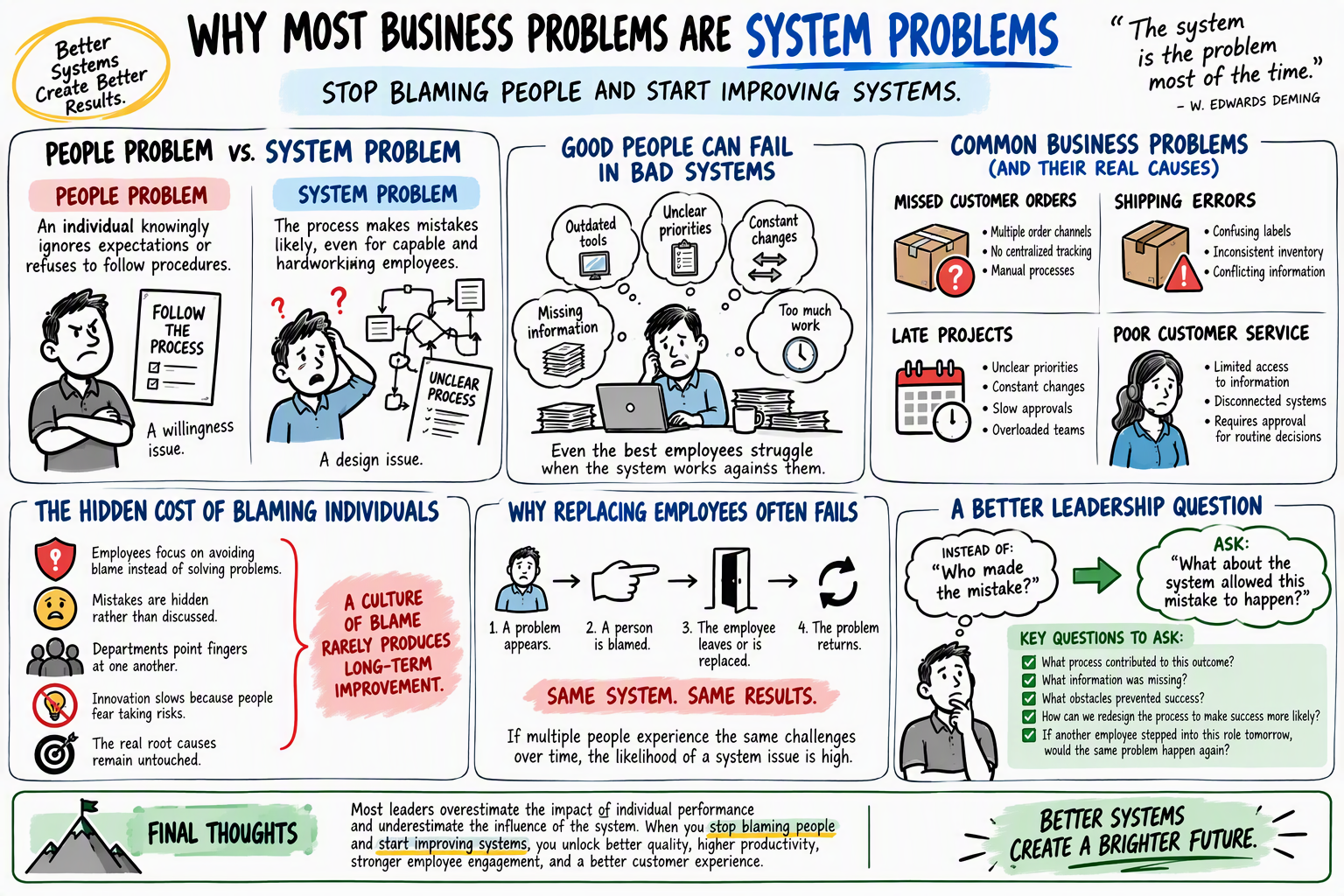
Why Most Business Problems Are System Problems
When something goes wrong in a business, the first instinct is often to find out who made the mistake. A customer order is missed, a shipment goes to the wrong address, a project falls behind schedule, or a client has a poor experience. The question that usually follows is, “Who is responsible?”
It's a natural reaction. Leaders want accountability, and accountability matters. But one of W. Edwards Deming's most important lessons was that most business problems are not people problems. They are system problems.
This idea can be uncomfortable because it challenges a belief many of us have been taught throughout our careers: that results are primarily driven by individual effort. While individual performance certainly matters, Deming argued that the systems people work within have a far greater influence on outcomes than most leaders realize.
Understanding this principle can fundamentally change how you lead, solve problems, and improve the performance of your organization.
The Difference Between a People Problem and a System Problem
A people problem exists when an individual knowingly ignores expectations, refuses to follow established procedures, or lacks the willingness to perform their role.
Those situations happen, but they are far less common than many leaders believe.
A system problem occurs when the process itself makes mistakes likely, even for capable and hardworking employees. These issues often stem from unclear procedures, poor communication, inadequate training, conflicting priorities, ineffective tools, unrealistic workloads, or management decisions that create barriers to success.
Consider the difference between these two scenarios:
People Problem
An employee intentionally bypasses a required safety procedure despite being trained and repeatedly reminded.
System Problem
Multiple employees fail to follow the same safety procedure because the process is confusing, time-consuming, poorly documented, or impossible to follow consistently under normal production demands.
One points to an individual. The other points to the design of the work.
The critical question for leaders is not, "Who made the mistake?"
It is:
What about the system allowed this mistake to happen?
Why Good Employees Often Fail in Bad Systems
One of the biggest leadership mistakes is assuming that strong employees can overcome a poorly designed system through hard work alone.
In reality, even exceptional employees struggle when the environment works against them.
Imagine asking a top-performing customer service representative to provide excellent support while using outdated software, incomplete customer records, inconsistent procedures, and constantly changing priorities. Their talent may help them achieve better results than others, but eventually the system will limit their performance.
The same principle applies throughout an organization.
- The most talented project manager cannot consistently deliver projects on time if resources are constantly shifted without notice.
- The most dedicated warehouse employee cannot avoid shipping errors if inventory records are inaccurate.
- The most customer-focused salesperson cannot create a great customer experience if internal departments operate in silos.
People can compensate for system weaknesses temporarily. They cannot eliminate them.
This is why organizations often experience the same problems repeatedly despite hiring talented individuals, providing training, or replacing employees.
The system remains unchanged.
The Hidden Cost of Blaming Individuals
When leaders focus exclusively on finding fault, they often create unintended consequences.
Employees become more concerned about avoiding blame than identifying problems.
Mistakes are hidden rather than discussed.
Departments begin pointing fingers at one another.
Innovation slows because people become reluctant to take risks.
Most importantly, the real root causes remain untouched.
A culture of blame may provide short-term emotional satisfaction because it appears decisive, but it rarely produces long-term improvement.
System-focused leaders take a different approach.
Instead of asking, "Who failed?" they ask:
- What process broke down?
- Where was communication unclear?
- What information was missing?
- What obstacles prevented success?
- How can we redesign the process so the mistake is less likely in the future?
Those questions lead to improvement rather than repetition.
Example: Missed Customer Orders
A business notices an increasing number of customer orders being overlooked.
Management immediately concludes that employees are being careless.
Several employees receive warnings, yet the problem persists.
A deeper investigation reveals that orders arrive through multiple channels: email, website forms, phone calls, and text messages. There is no centralized tracking system, and employees are expected to manage all incoming requests manually.
The issue was never a lack of effort.
The issue was a system that depended on people remembering dozens of disconnected tasks.
Replacing employees would not solve this problem. Creating a reliable order management process would.
Example: Shipping Errors
A company receives frequent complaints about incorrect shipments.
Management blames warehouse workers and increases performance pressure.
The mistakes continue.
After reviewing the process, leadership discovers that product labels are difficult to distinguish, inventory locations are inconsistently marked, and order documents contain conflicting information.
The warehouse employees were working hard.
The process set them up to fail.
Improving labeling standards, simplifying documentation, and organizing inventory would likely reduce errors dramatically without changing personnel.
Example: Late Projects
Many organizations assume project delays occur because employees lack urgency.
Sometimes that is true.
More often, schedules slip because priorities are unclear, requirements change constantly, approvals take too long, or teams are overloaded with competing commitments.
In these situations, project delays are symptoms, not causes.
The root issue is a system that lacks the structure necessary for predictable execution.
When leaders focus exclusively on pushing people harder, they often increase stress without improving outcomes.
When they improve planning, communication, decision-making, and resource allocation, projects become more reliable.
Example: Poor Customer Service
A company receives negative customer feedback and immediately focuses on coaching front-line employees.
Additional training is provided.
Customer satisfaction barely improves.
Eventually leadership discovers that service representatives lack access to accurate customer information, must navigate multiple disconnected systems, and require manager approval for routine decisions.
Customers experience delays and frustration because employees operate within a system that prevents them from delivering fast, effective service.
The solution is not simply better customer service training.
The solution is improving the environment in which customer service occurs.
Why Replacing Employees Often Fails
Many organizations unknowingly fall into a frustrating cycle.
- A problem appears.
- A person is blamed.
- The employee leaves or is replaced.
- The problem returns.
Leadership becomes confused because they believed they had fixed the issue.
What actually happened is that they changed the person while leaving the system intact.
The new employee enters the same environment, faces the same obstacles, follows the same processes, and eventually encounters the same problems.
This pattern is one of the clearest indicators of a system issue.
If multiple people experience the same challenges over time, the likelihood that the system is contributing to the problem increases dramatically.
Strong leaders know that sustainable improvement comes from improving how work is designed, not simply changing who performs it.
A Better Leadership Question
One of the most powerful shifts a leader can make is replacing blame with curiosity.
The next time a problem occurs, resist the urge to immediately identify the responsible person.
Instead, ask:
- What process contributed to this outcome?
- What conditions allowed this mistake to occur?
- What information was missing?
- How could the system be redesigned to make success more likely?
- If another employee stepped into this role tomorrow, would the same problem happen again?
Those questions move the organization from reacting to improving.
Over time, this approach builds trust, encourages transparency, and creates a culture where problems are exposed and solved rather than hidden.
Final Thoughts
Deming believed that most leaders dramatically overestimate the impact of individual performance while underestimating the influence of the system.
After years of leading teams, managing operations, implementing enterprise systems, and helping organizations improve performance, I've found this principle to be remarkably accurate.
Most employees come to work wanting to do a good job. When results consistently fall short, the most valuable leadership response is not to ask who failed. It is to understand why the system produced the result it did.
When leaders stop blaming people and start improving systems, they unlock better quality, higher productivity, stronger employee engagement, and a better customer experience.
The greatest opportunity for improvement is usually not found in replacing people.
It is found in redesigning the system so ordinary people can consistently achieve extraordinary results.
Sources
-
- Edwards Deming, Out of the Crisis
-
- Edwards Deming, The New Economics for Industry, Government, Education
- Deming Institute teachings on systems thinking and variation
- Peter Scholtes, The Leader's Handbook
- Russell Ackoff's work on systems thinking and organizational performance
- American Society for Quality (ASQ) resources on quality management and process improvement
- Institute for Healthcare Improvement (IHI) resources on systems-based improvement