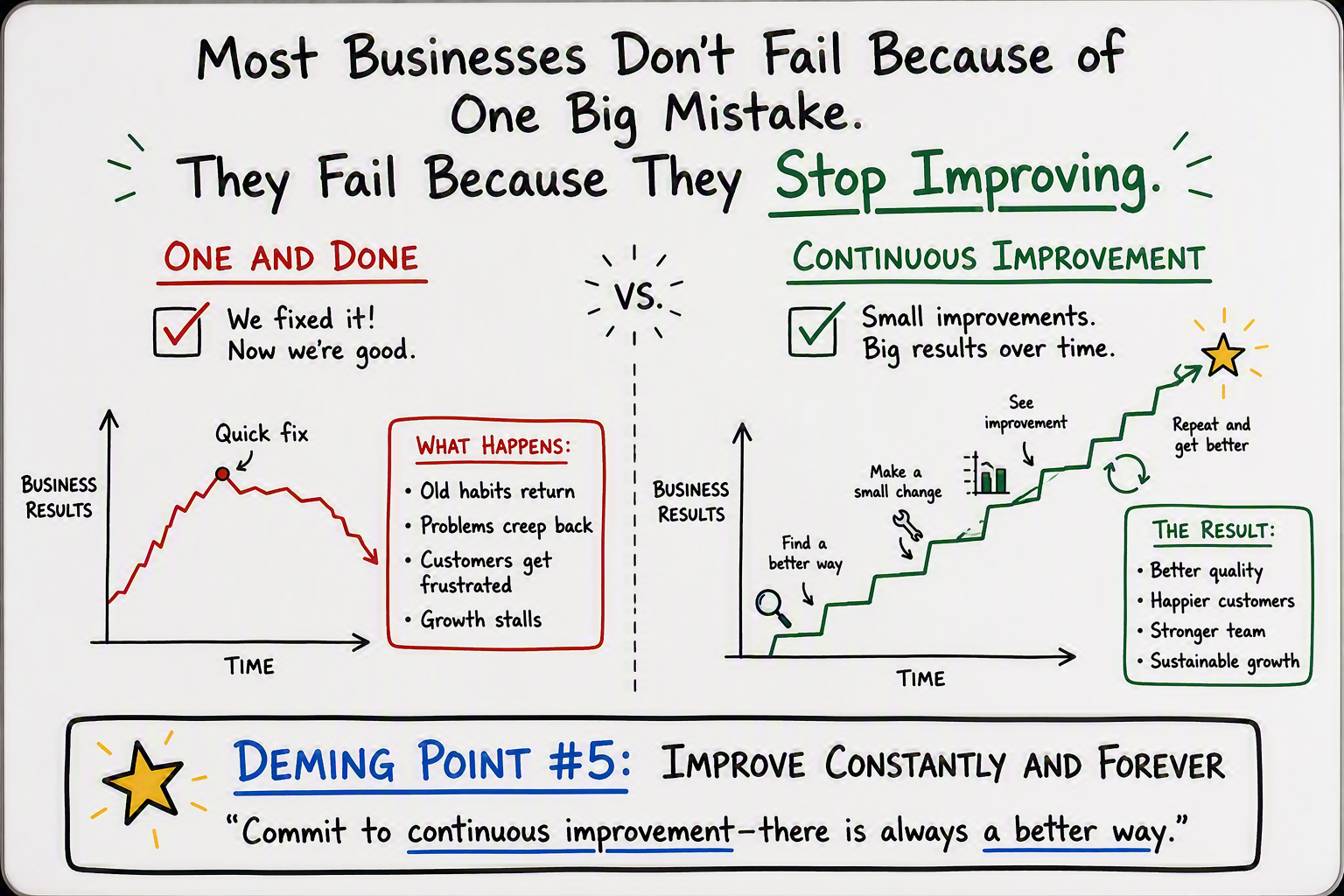
Why Continuous Improvement Matters: Deming's Point #5 for Small Business Growth
If I had to choose one habit that separates companies that grow from companies that stagnate, it would be this:
The best organizations never stop improving.
Not when sales are good.
Not when business is booming.
Not when things are running smoothly.
They understand that improvement is not a project.
It's a way of operating.
That's the heart of Deming's Point #5:
"Improve constantly and forever the system of production and service."
Deming argued that organizations should continuously improve quality, productivity, and processes rather than treating improvement as a one-time initiative.
For small business leaders, this may be one of the most powerful ideas in the entire 14 Points for Management.
The Improvement Trap Many Small Businesses Fall Into
Most businesses improve only when they are forced to.
- A major customer complains.
- Profits decline.
- An employee quits.
- A competitor gains market share.
- A significant problem appears.
Then the organization reacts.
Deming's philosophy was different.
He believed improvement should happen before a crisis occurs, not after.
The businesses that thrive are usually making hundreds of small improvements long before they become necessary.
Why Small Businesses Have an Advantage
Large organizations often need committees, approvals, and months of planning before making changes.
Small businesses can improve this week.
You can:
- Simplify a process tomorrow
- Update a checklist today
- Improve training this month
- Remove bottlenecks immediately
Small organizations are often more agile than large corporations.
The challenge isn't capability.
The challenge is making continuous improvement a priority.
A Real-World Example: Toyota and Kaizen
One of the most well-known examples of continuous improvement is Toyota's use of Kaizen, the practice of making ongoing incremental improvements over time.
Toyota did not become a global leader because of one breakthrough innovation.
It became successful through thousands of small improvements made consistently over decades. Leaders and employees are encouraged to identify opportunities for improvement, reduce waste, solve problems, and continuously improve the system.
What makes this relevant to small businesses is that Kaizen does not require massive budgets.
Most improvements are small:
- A simpler form
- A better workflow
- A clearer procedure
- A faster setup process
- A more effective way to serve customers
Small improvements applied consistently compound into significant results over time.
Continuous Improvement Is a Competitive Advantage
Many business owners are looking for the next big idea:
- The next product
- The next customer
- The next marketing strategy
Meanwhile, their competitors are quietly improving:
- Customer response times
- Product quality
- Employee training
- Delivery performance
- Internal processes
Over time, these small improvements become difficult to compete against.
Improvement compounds just like interest compounds.
Five Practical Actions Small Business Leaders Can Take
1. Improve One Thing Every Month
Don't try to overhaul the entire company.
Pick one:
- A process
- A workflow
- A report
- A customer interaction
Small wins build momentum.
2. Ask One Question Every Week
Ask your team:
"What's one thing slowing you down right now?"
You'll often uncover improvement opportunities hiding in plain sight.
3. Track Recurring Frustrations
Pay attention to:
- Repeated mistakes
- Customer complaints
- Delays
- Rework
- Bottlenecks
Recurring problems often point directly to the next improvement opportunity.
4. Celebrate Improvements
Most companies celebrate results.
Great companies celebrate learning and improvement.
Recognize employees who make processes better.
5. Make Improvement Part of the Job
Improvement shouldn't belong only to managers.
Everyone should be encouraged to identify problems and propose solutions.
Some of the best ideas come from the people closest to the work.
What This Means for Growth
Many organizations spend years searching for dramatic breakthroughs.
Meanwhile, the most successful organizations keep improving steadily.
Deming understood that long-term success is rarely the result of one big change.
It's usually the result of consistent improvement over time.
That's encouraging for small businesses because you don't need massive resources to improve.
You simply need commitment.
Final Thought
Improvement isn't something you do when you have extra time.
Improvement is what creates extra time.
The businesses that are easiest to lead tomorrow are usually the ones being improved today.
Deming's Point #5 reminds us that excellence is not an event.
It's a habit.
Reflection Question
What's one small improvement you've made recently that had a bigger impact than you expected?