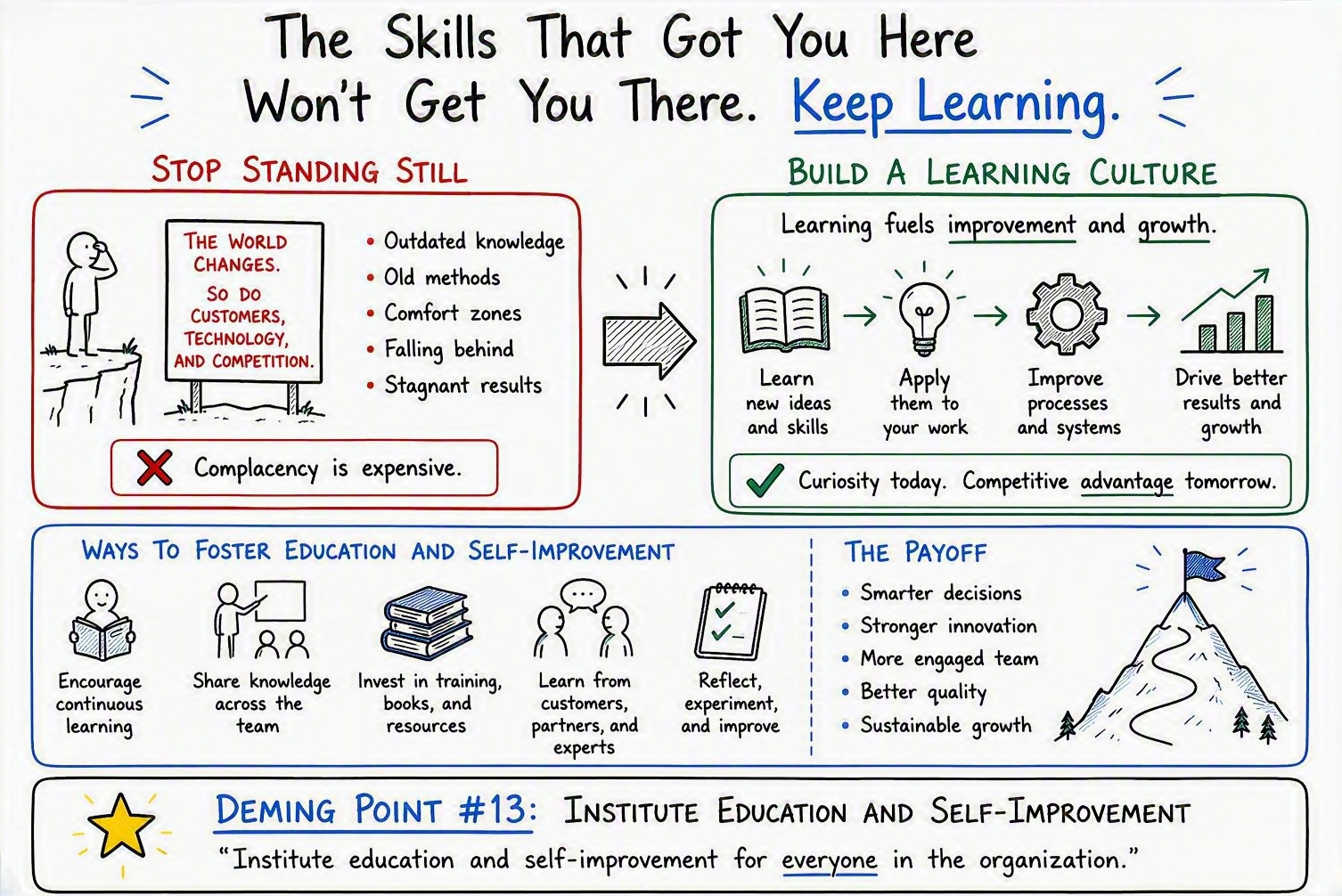
Deming Point #13: Institute a Vigorous Program of Education and Self-Improvement
If Deming were walking through businesses today, I suspect he would ask a simple question:
Are you developing your people for today's job, or preparing them for tomorrow's challenges?
That's the essence of Deming's Point #13: Institute a vigorous program of education and self-improvement.
Many organizations invest in training people how to perform their current tasks.
Far fewer invest in helping people grow beyond those tasks.
Deming believed organizations should continually help people expand their knowledge, skills, and capabilities because long-term success depends on the development of people, not just processes.
For small businesses, this may be one of the most overlooked competitive advantages available.
Training and Education Are Not the Same Thing
Many leaders use these terms interchangeably.
They're actually very different.
Training
Training teaches people how to perform a specific task.
Examples include:
- Operating a machine
- Using a software application
- Following a process
- Completing a customer transaction
Education and Self-Improvement
Education helps people think more effectively and contribute more broadly.
Examples include:
- Leadership development
- Communication skills
- Problem-solving
- Financial literacy
- Process improvement
- Project management
Training helps people do their job today.
Education helps people become more valuable tomorrow.
Deming believed organizations needed both.
The Small Business Myth
Many small business owners believe they cannot afford employee development.
I would argue that many businesses cannot afford not to develop their people.
Consider the cost of:
- Poor decisions
- Repeated mistakes
- Limited leadership capacity
- Employee turnover
- Difficulty promoting from within
Those costs often exceed the investment required to help employees grow.
One of the biggest limitations to business growth isn't a lack of opportunity.
It's a lack of capable people ready to take on larger responsibilities.
A Real-World Example: The Ritz-Carlton
The Ritz-Carlton is known not only for training employees but also for creating a learning-focused culture that emphasizes leadership development, service excellence, coaching, and continuing education.
Employees receive structured development opportunities, and leaders are expected to continuously improve their capabilities as well.
The company understands something many organizations miss:
The customer experience rarely exceeds the capability of the workforce delivering it.
By investing heavily in development, Ritz-Carlton has built a reputation for service excellence that continues across locations, leaders, and generations of employees.
Small businesses can apply the same principle.
You may not have the same budget.
You absolutely can adopt the same mindset.
Why Self-Improvement Matters
The business environment changes constantly.
- New technologies
- New customer expectations
- New competitors
- New regulations
- New business models
Organizations that stop learning eventually fall behind.
The same is true for individuals.
Employees who continuously learn become more adaptable, more engaged, and more capable of contributing to future success.
What Education Looks Like in a Small Business
Education does not require a corporate university.
It can include:
- ✅ Books
- ✅ Online courses
- ✅ Industry certifications
- ✅ Lunch-and-learn sessions
- ✅ Conference attendance
- ✅ Cross-training
- ✅ Mentoring
- ✅ Leadership development
- ✅ Problem-solving workshops
Often the best development opportunities are surprisingly affordable.
Five Practical Actions for Small Business Leaders
1. Create Individual Development Goals
Ask every employee:
"What new skill would help you become more valuable over the next year?"
Then help them pursue it.
2. Build Learning Into the Schedule
Many organizations say learning is important.
Few actually allocate time for it.
Even one hour per month can create meaningful progress.
3. Create a Shared Reading Culture
Consider encouraging:
- Leadership books
- Industry articles
- Business case studies
- Process improvement resources
Learning often sparks valuable conversations.
4. Encourage Cross-Training
Cross-training helps employees:
- Understand the business better
- Appreciate other functions
- Build new competencies
- Increase flexibility
It also reduces organizational risk.
5. Invest in Future Leaders
One of the most important questions a business owner can ask is:
"Who are the next leaders in this organization?"
Don't wait until you need them.
Start developing them now.
What This Means for Growth
Most companies spend significant money on:
- Equipment
- Software
- Marketing
- Buildings
- Processes
The most successful organizations also invest in people.
Deming understood that continuous improvement requires continuous learning.
The organization's ability to grow is directly linked to the growth of the people inside it.
A business can never sustainably outperform the capabilities of its workforce.
Final Thought
One of the best investments a business can make is helping people become more capable than their current role requires.
Some leaders worry:
"What if we invest in people and they leave?"
A better question might be:
"What if we don't invest in people and they stay?"
Deming's Point #13 reminds us that developing people isn't an expense.
It's one of the most important responsibilities of leadership.
Organizations that invest in learning, growth, and self-improvement create stronger leaders, more capable teams, and more sustainable business success.
What skill are you currently working to develop in yourself or your team?