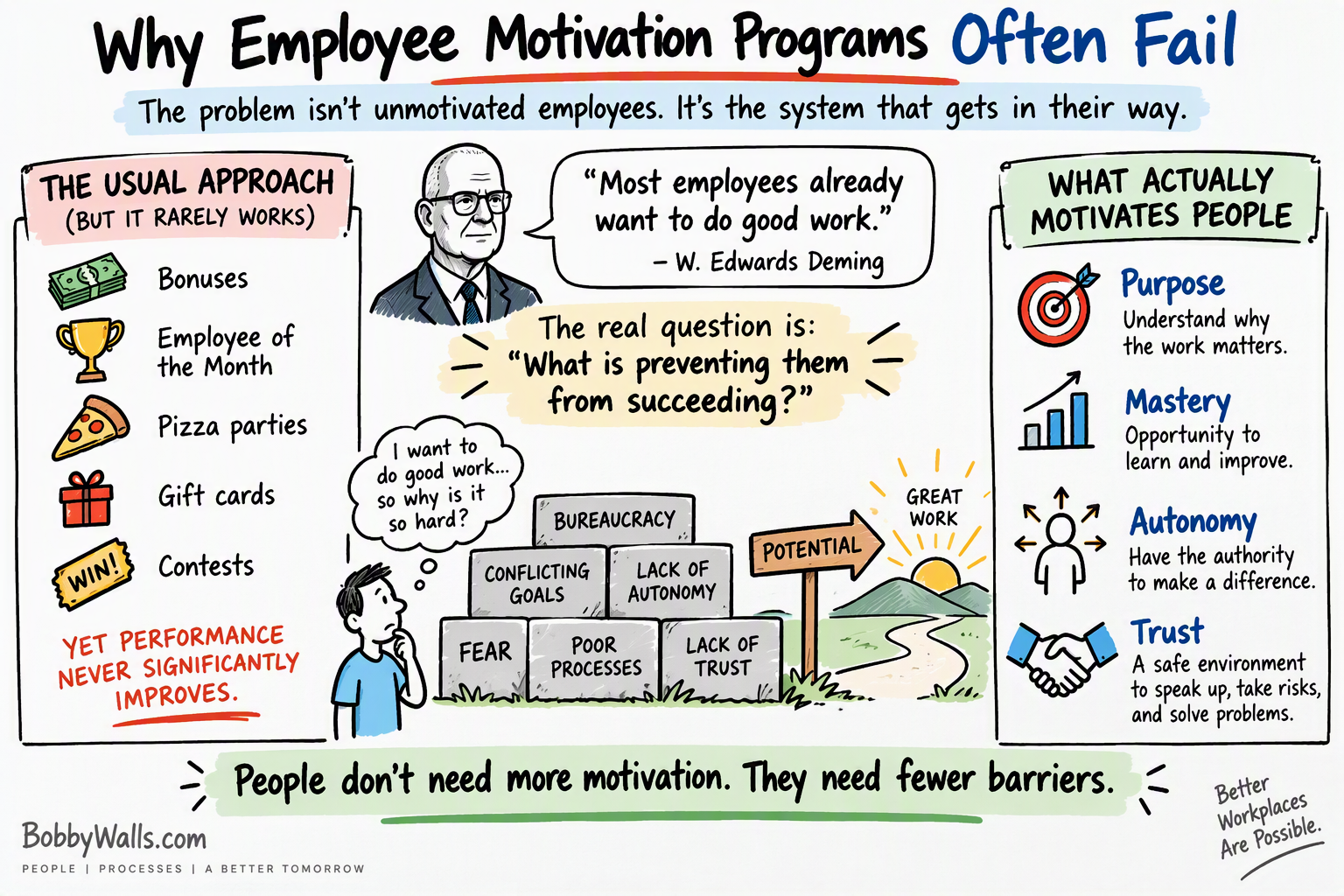
Why Employee Motivation Programs Often Fail
Most organizations want motivated employees.
So when engagement drops or performance stalls, management often reaches for familiar tools:
- Bonuses
- Employee of the Month awards
- Pizza parties
- Gift cards
- Contests
- Recognition programs
There is nothing inherently wrong with giving someone a bonus, buying lunch for the team, or recognizing good work.
The problem begins when we expect those things to create motivation.
- Edwards Deming approached the problem very differently. His management philosophy emphasized the system in which people work and warned against practices that replace cooperation and pride in workmanship with fear, rankings, incentives, and competition.
That leads to a very different management question.
Instead of asking:
How do we motivate our employees?
Perhaps we should ask:
What are we doing that prevents good employees from doing their best work?
That is a much harder question.
It is also usually the more productive one.
Most People Want to Do Good Work
One of the ideas I've come to appreciate about Deming is how much responsibility his philosophy places on management.
It is easy to blame poor results on employees:
- They aren't motivated enough.
- They don't care.
- They need more accountability.
- They need an incentive.
But what if the employee isn't the primary problem?
Deming's philosophy asks management to examine the system surrounding the employee: the processes, tools, objectives, measures, training, leadership, information, and organizational structure that shape how work gets done.
Imagine an employee who wants to serve a customer well but needs approval from three different people.
Or an employee measured on speed while being told quality is the company's top priority.
Or a supervisor responsible for improving productivity who has no authority to fix an obvious bottleneck.
Or someone who raises the same problem for six months and eventually stops bringing it up because nothing happens.
At some point, is the problem really motivation?
Extrinsic Motivation Has Limits
Extrinsic motivation comes from something outside the work itself:
- Bonuses
- Gift cards
- Contests
- Prizes
- Rankings
- Recognition
- Performance incentives
Intrinsic motivation comes from within:
- Satisfaction from solving a difficult problem
- Pride in producing quality work
- Learning something new
- Helping a customer
- Becoming better at a craft
- Being part of something worthwhile
Both exist in the workplace. Compensation obviously matters. People work for money, and good performance should not become an excuse for underpaying people.
But there is a difference between paying people fairly and attempting to manage them primarily through rewards.
The danger comes when management assumes every performance problem can be solved by attaching another carrot to it.
Sometimes the carrot isn't fixing the problem.
It is distracting us from it.
When Rewards Accidentally Create Competition
Consider a sales contest.
Management announces that the top salesperson this quarter wins $5,000.
It sounds perfectly reasonable. Sell more, earn more.
But think about what the organization has just communicated.
Only one person can win.
A salesperson who discovers an effective technique now has less reason to share it. Someone receiving a promising lead may want to keep it. Helping another salesperson could reduce your own chance of winning.
The company wants teamwork while the incentive system rewards individual competition.
That is a system problem.
The same thing can happen with production bonuses, individual quotas, forced rankings, and departmental targets:
- Marketing can hit its target while making life harder for operations.
- Purchasing can reduce unit cost while increasing inventory.
- Production can maximize output while creating excess work-in-process.
- Customer service can reduce average call time while frustrating customers.
Each department can "win" while the business loses.
Fear May Produce Activity, but Not Improvement
Another powerful part of Deming's philosophy is his call to drive out fear.
Fear is surprisingly effective in the short term.
Tell people their jobs depend on hitting a number and behavior will change quickly.
But perhaps not in the way management intended.
When people are afraid, they naturally protect themselves:
- Problems become harder to see.
- Bad news travels more slowly.
- Numbers become more important than reality.
- People become reluctant to experiment because experiments can fail.
- Employees stop asking questions that might make them look incompetent.
- Managers explain away problems rather than exposing them.
Eventually, leadership receives exactly what it asked for: good-looking reports.
Unfortunately, the underlying system may be getting worse.
A healthy organization needs people willing to say:
Something isn't working.
That is valuable information. Leadership should want to hear it early.
Why Recognition Programs Sometimes Backfire
Recognition itself isn't bad.
In fact, genuinely appreciating someone's contribution can be incredibly meaningful.
The problem is turning appreciation into another management system.
Take Employee of the Month.
One employee gets recognized. Twenty-nine don't.
Maybe the winner is outstanding. Or maybe that person worked on the most visible project.
Maybe another employee prevented a major problem that nobody noticed because the problem never happened. Maybe someone else spent hours helping coworkers succeed.
An attempt to recognize one person can unintentionally communicate something very different to everyone else:
This is what the organization considers valuable.
That is why recognition should be thoughtful.
Specific recognition from a manager who understands someone's contribution is very different from a generic program designed to manufacture engagement.
“I appreciate how you stayed with that customer problem until we understood the root cause.”
That has meaning.
“Congratulations, you're Employee of the Month.”
That may not, especially when people don't understand how the decision was made.
What Actually Helps People Stay Motivated?
Rather than constantly searching for new ways to motivate people, leaders can focus on building an environment where motivation has a chance to survive.
Four things matter enormously.
Purpose
People should understand why their work matters.
That doesn't require an inspirational corporate mission statement hanging in the lobby. Sometimes purpose is very practical.
A machinist needs to understand how a tolerance affects the customer's product. An IT employee should understand the business process behind the system being supported. A customer service employee should understand what a successful customer experience actually looks like.
When people see the connection between their work and the outcome, the work becomes more meaningful.
Mastery
Most people enjoy becoming good at something.
Give them the opportunity.
Training helps, but mastery requires more than sending someone to a class. It requires time to learn, opportunities to solve problems, feedback, coaching, experimentation, and permission to improve the way work is performed.
Autonomy
People closest to the work often see problems long before senior management does.
Yet many organizations give those employees very little authority to change anything. Then management wonders why they stop making suggestions.
Autonomy doesn't mean everyone does whatever they want. It means giving capable people reasonable authority to make decisions within a well-understood system.
If every small decision requires approval, people eventually learn the safest behavior:
Wait to be told what to do.
Then management complains that employees aren't taking initiative.
Trust
Trust may be the most important of the four.
If employees believe mistakes will be punished, problems will be hidden.
If managers don't trust employees, they create more controls. Employees respond by becoming more cautious. Management interprets that caution as a lack of initiative, so more controls follow.
It is a vicious cycle.
Trust breaks that cycle.
People need to know they can raise a problem without becoming the problem.
Before Launching Another Motivation Program, Look at the System
Suppose engagement is falling.
Before launching the next incentive program, start asking different questions:
- What makes it unnecessarily difficult for employees to do good work?
- Where are they waiting for approvals?
- What recurring problems have they learned to work around?
- Are departments working toward competing goals?
- Do employees have the tools and training they need?
- Are managers rewarding one behavior while asking for another?
- Do people feel safe bringing bad news forward?
- Can employees improve a process when they see something that isn't working?
Those questions aren't nearly as exciting as announcing a new bonus program.
But the answers may reveal far more about performance.
Remove the Barriers
A pizza party isn't going to fix a broken process.
A gift card won't fix conflicting objectives.
Employee of the Month won't fix poor training.
A bonus won't necessarily fix bad information.
And a motivational speech won't create trust.
The better approach is often less about adding something and more about removing something.
Remove unnecessary bureaucracy.
Remove conflicting goals.
Remove fear.
Remove obstacles to doing quality work.
Remove systems that force good employees to fight the organization just to accomplish their jobs.
Then give people purpose, opportunities to develop mastery, appropriate autonomy, and leadership they can trust.
The goal isn't to manufacture motivation.
It is to stop destroying it.
People don't always need more motivation. Sometimes they simply need fewer barriers standing between them and doing work they're proud of.