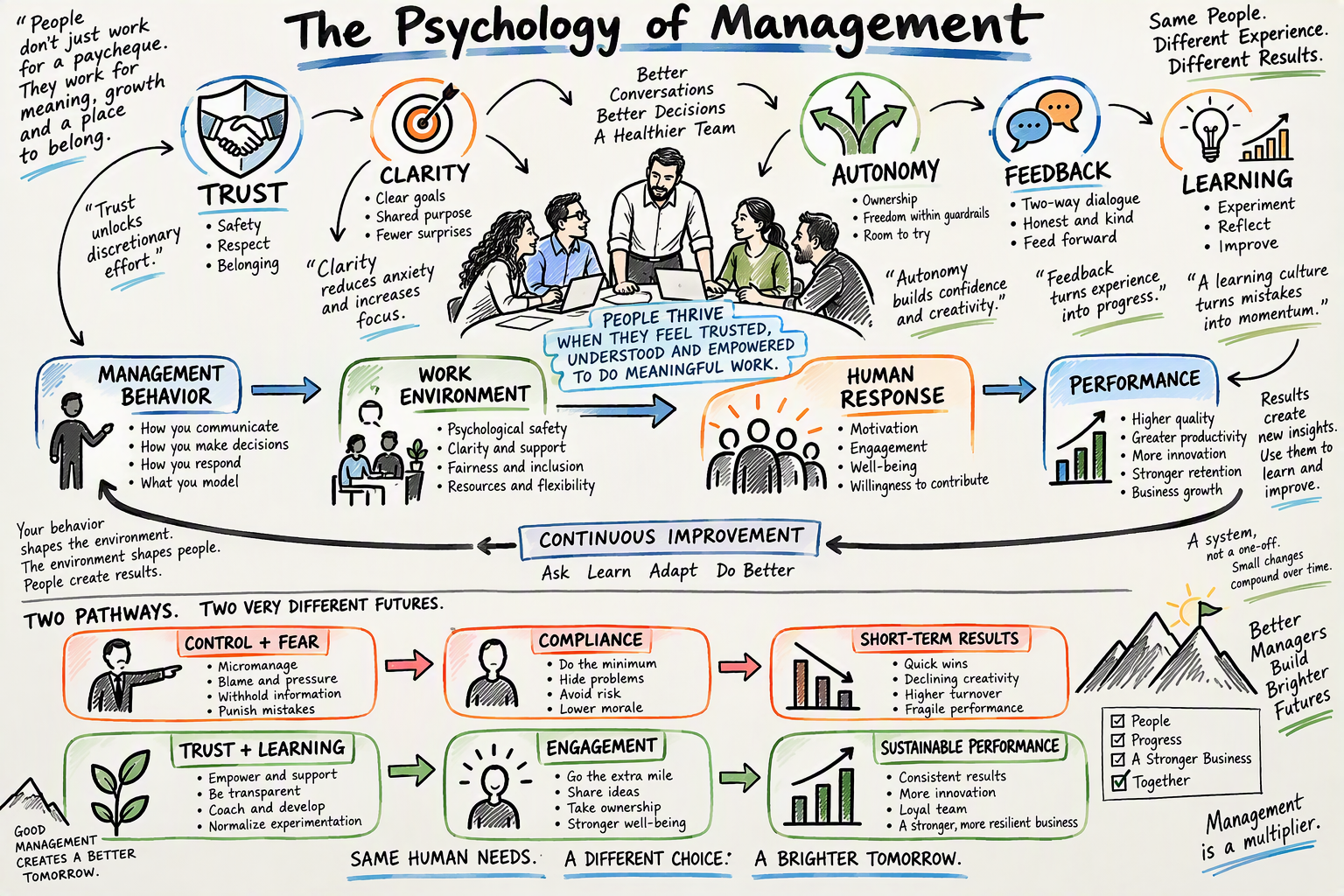
The Psychology of Management Management is often discussed as if it were primarily a technical discipline. Set goals. Define responsibilities. Measure performance. Hold people accountable. Those things matter. But anyone who has managed people for very long eventually discovers something else. You are not managing job descriptions. You are managing human beings. People bring ambition, pride, insecurity, judgment, experience, habits, relationships, and different interpretations of the same situation to work every day. Two employees can receive exactly the same instruction and respond very differently. A manager can intend to create accountability and accidentally create fear. An incentive designed to improve performance can change behavior in ways nobody anticipated. That is why I believe understanding psychology is one of the most overlooked parts of management. It also connects directly with several subjects in this series, particularly systems thinking, variation, and the limitations of employee motivation programs. People Respond to the Environment We Create One of W. Edwards Deming's most important contributions to management was his insistence that we stop automatically blaming individuals for problems that are largely produced by the system in which they work. Deming famously argued that a large majority of performance problems belong to the system and therefore fall under management's responsibility. Think about what that means in practice: If several good employees repeatedly struggle with the same process, is it really an employee problem? If customer complaints keep occurring at the same point in an operation, should we immediately look for someone to blame? If turnover is consistently high under one management structure, is the solution simply to hire more "motivated" people? Sometimes an individual truly is the problem. Poor performance exists. Bad decisions exist. People occasionally end up in jobs that aren't right for them. But individual accountability should not prevent us from asking a more useful question:
What is it about the environment that makes this behavior likely? That's a very different management question. Instead of asking, "Who messed this up?" we begin asking, "Why was it so easy for this to go wrong?" That distinction changes organizations. Fear Is a Terrible Management System Deming included "drive out fear" among his famous 14 Points for Management. That sounds simple. It isn't. Fear rarely announces itself inside an organization. Employees don't normally walk into the boss's office and say, "I have decided not to tell you the truth because I'm worried about how you'll react." They simply stop telling you things. Problems get quietly fixed instead of reported. Bad numbers receive explanations before analysis. Employees learn which opinions are welcome and which ones aren't. Meetings become places where people agree publicly and question privately. Eventually, management starts receiving a filtered version of reality. That is dangerous. The higher someone moves in an organization, the easier it becomes for this to happen. People naturally pay attention to what the person with authority rewards, criticizes, ignores, or reacts strongly to. Managers therefore have an uncomfortable responsibility: we have to make it safe to tell us things we don't want to hear. That doesn't mean eliminating standards or avoiding difficult conversations. Psychological safety and accountability are not opposites. A healthy organization needs both. Incentives Change the Game One of my favorite lessons in management is also one of the simplest: Tell me how you measure people, and I'll show you how people will begin behaving. Suppose a sales team is rewarded entirely for revenue. Revenue will probably get attention. But what happens to: Margin? Customer fit? Returns? Long-term relationships? Cooperation between salespeople? Or suppose a service department is measured primarily on how quickly employees close customer tickets. The organization may soon discover that tickets are being closed very efficiently while customers remain frustrated. People aren't necessarily being dishonest. They're responding rationally to the system management created. This is one reason motivation programs can produce disappointing results, a subject I discuss elsewhere in this series. The problem isn't that incentives never work. They certainly can. The problem is assuming that an incentive affects only the behavior we intended to change. Human beings are much more creative than our measurement systems. Intrinsic Motivation Matters Most people want to do good work. I think managers sometimes underestimate this. We build elaborate systems to motivate employees while unintentionally removing some of the things that make work motivating in the first place: Autonomy Mastery Purpose Pride Trust The ability to see the results of one's work Simon Sinek captured part of this idea when he wrote: "Working hard for something we don't care about is called stress. Working hard for something we love is called passion." The practical lesson isn't that every employee must be passionate about every task. That's unrealistic. The lesson is that meaning changes how people experience work. Someone sweeping the floor can believe they're completing a chore, or they can understand that cleanliness is part of the customer's perception of the entire business. Someone entering data can believe they're filling in boxes, or understand that another employee will make an important decision based on the accuracy of that information. Good managers connect tasks to consequences. They help people understand why their work matters. What You Do Teaches More Than What You Say Culture is shaped by what leaders repeatedly tolerate and reinforce. If a manager says quality matters but celebrates production volume regardless of defects, employees learn what actually matters. If a manager says employees should speak openly but becomes defensive whenever someone disagrees, employees learn that lesson too. If management talks about teamwork but rewards only individual results, don't be surprised when employees protect their own territory. People are remarkably good observers of managerial behavior. They notice the difference between the official rules and the real rules. This is one reason I like Simon Sinek's observation: "Leadership is not about being in charge. Leadership is about taking care of those in your charge." Authority can make someone a manager. It cannot make people trust them. Trust develops through repeated experience. The Manager Changes the System Simply by Observing It There is another psychological reality managers should understand: Your presence changes behavior. Walk through a department and people behave somewhat differently. Attend a meeting you don't normally attend and the conversation may change. Ask employees why a metric declined and that metric suddenly becomes more important. This isn't necessarily manipulation. It's human nature. People pay attention to what leadership pays attention to. That gives managers enormous influence, but it also creates a trap. If we react dramatically every time a number moves in the wrong direction, employees learn to manage our reactions rather than improve the underlying process. This is where psychology and variation intersect. Not every bad result has a special cause. Sometimes we are simply observing normal variation within an imperfect system. Treating every fluctuation as a crisis creates nervous organizations where employees spend their time reacting instead of learning. Understanding variation, another topic in this series, becomes as much a management discipline as a statistical one. Ask Better Questions One of the easiest ways to change management behavior is to change the questions managers ask. Instead of: Who made the mistake? Try: What allowed this mistake to happen? Instead of: Why aren't they motivated? Try: What makes succeeding in this environment unnecessarily difficult? Instead of: How do we make employees accountable for this number? Try: How much control do they actually have over this number? Instead of: Why didn't anyone tell me? Ask: What might have made people reluctant to tell me? These questions don't eliminate individual responsibility. They simply prevent individual responsibility from becoming an excuse for managerial responsibility. The Psychology of the Manager Matters Too Perhaps the most uncomfortable part of management psychology is recognizing that managers are subject to the same biases as everyone else. We like evidence that confirms what we already believe. We remember our successes more clearly than our mistakes. We confuse confidence with competence. We sometimes attribute another person's failure to character while attributing our own failure to circumstances. And once we've made a decision publicly, we tend to defend it longer than we probably should. Experience helps, but experience can also make those tendencies harder to recognize. A manager with 20 years of experience can have 20 years of learning, or one year of experience repeated 20 times. That is why humility is such an underrated management skill. The best managers I've encountered aren't people who always have the answer. They're people who remain willing to discover that their answer is wrong. Management Is the Design of Human Systems Businesses need processes, standards, measurements, financial controls, and accountability. But every one of those systems eventually interacts with human psychology. People: Respond to incentives Protect themselves from perceived threats Look for meaning Compare what leaders say with what leaders do Adapt to measurement Form habits Learn what is safe to discuss Behave differently depending on the systems surrounding them That's why management cannot simply be the supervision of people. At its best, management is the thoughtful design of an environment in which ordinary people have a reasonable chance to do excellent work. And when they don't, our first instinct shouldn't always be to ask what's wrong with them. Sometimes the better question is what's wrong with the system. That question is harder. It's also where management begins. Sources
- Edwards Deming, Out of the Crisis
- Edwards Deming, The New Economics for Industry, Government, Education The Deming Institute, teachings on the 14 Points for Management, systems thinking, and driving out fear Simon Sinek, writings and talks on leadership, purpose, and organizational culture Edward L. Deci and Richard M. Ryan, research on self-determination theory and intrinsic motivation Amy C. Edmondson, The Fearless Organization Daniel H. Pink, Drive: The Surprising Truth About What Motivates Us Peter Scholtes, The Leader's Handbook Chris Argyris, research on organizational learning and defensive routines