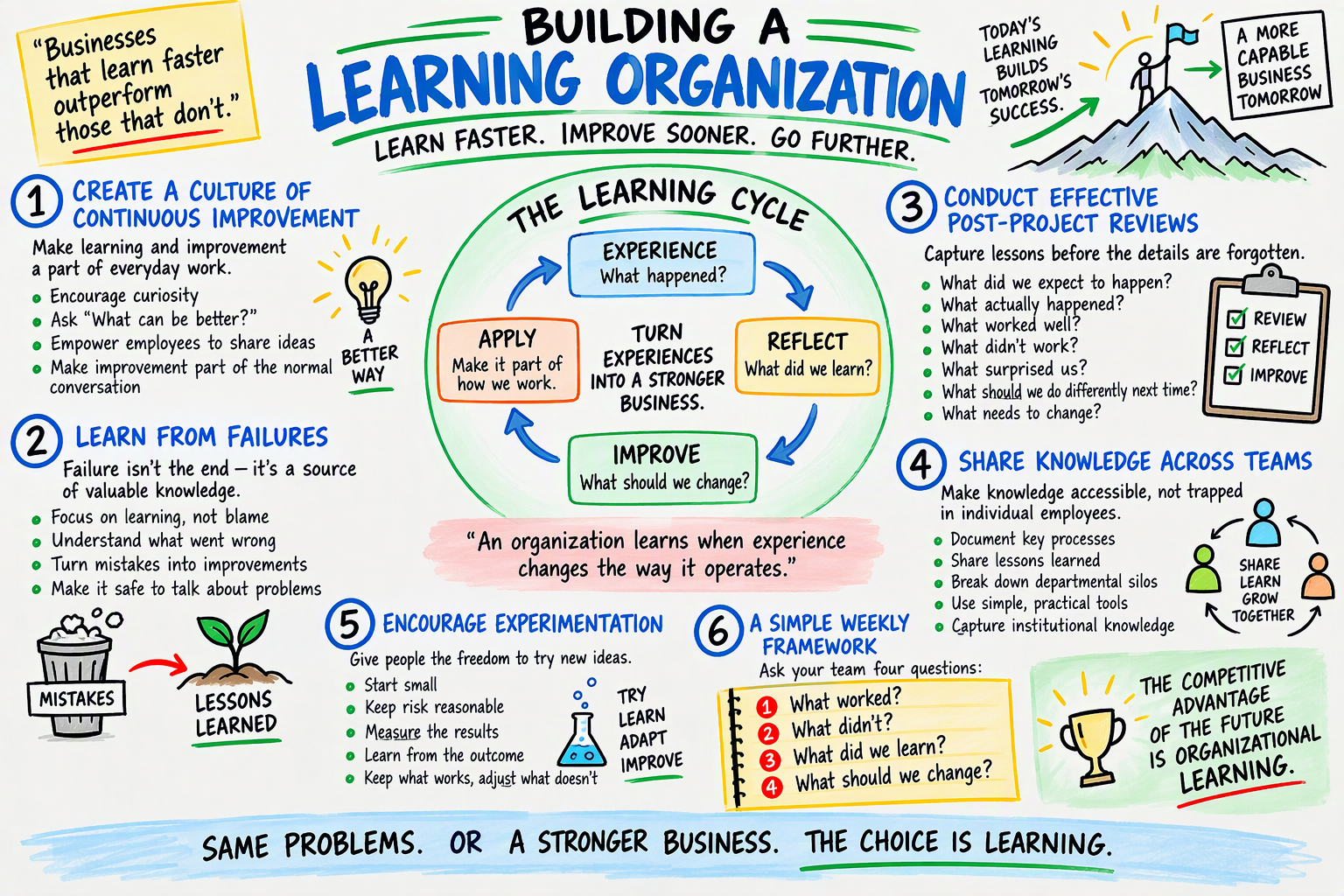
Building a Learning Organization: Your Next Competitive Advantage
One of the most frustrating things to see in an organization is the same problem happening over and over again.
A project runs into trouble.
Everyone works hard to get it back on track.
The team gets through it.
People talk about what went wrong.
Then everyone moves on.
Six months later, a different project encounters almost exactly the same problem.
The names may have changed. The customer may be different. Maybe it's a different department.
But the underlying problem is the same.
The organization experienced something.
The people involved learned from it.
But the organization didn't.
There is an important difference between people learning and an organization learning.
People learn when they gain experience.
An organization learns when that experience changes the way the organization operates.
That may mean changing a process, updating documentation, improving training, modifying software, changing a policy, or simply sharing what was learned with people who weren't involved the first time.
Without that step, knowledge remains trapped inside individual employees.
And when those employees leave, the knowledge often leaves with them.
For small businesses especially, I believe the ability to learn quickly can become a significant competitive advantage.
You may not have the resources of a much larger competitor.
But you can learn faster.
Continuous Improvement Doesn't Have to Be Complicated
When people hear "continuous improvement," they sometimes imagine a formal Lean program, teams of consultants, complicated charts, and months of training.
It doesn't have to look like that.
At its core, continuous improvement is simply a habit.
Something happens.
We observe what happened.
We learn from it.
We make an adjustment.
Then we see whether the adjustment helped.
The important part is actually completing the cycle.
Many organizations are pretty good at identifying problems.
Far fewer are good at turning what they discover into a permanent improvement.
A customer complains about an incorrect shipment.
We fix the customer's order.
Problem solved.
But did we learn anything?
- Why was the order incorrect?
- Could it happen again?
- Has it happened before?
- Does the process need to change?
- Does someone need additional training?
- Is information being entered incorrectly?
- Is the software confusing?
- Is there a handoff between departments where information is being lost?
Fixing the customer's immediate problem is important.
Preventing the next customer from having the same problem is organizational learning.
Failure Should Produce Something Valuable
Failure is expensive.
A failed project costs money.
A quality problem creates scrap or rework.
A lost customer costs revenue.
A bad hire consumes time and resources.
An equipment failure interrupts production.
A poor decision can set an organization back months.
We can't eliminate every failure.
But we can get something in return for it.
Knowledge.
One of the worst outcomes isn't simply failing.
It's paying for the lesson and then not learning it.
That doesn't mean every failure needs a lengthy investigation.
Sometimes things just go wrong.
But when an important project fails, a significant customer is lost, or a recurring problem appears again, leaders should be curious.
Not:
Who screwed this up?
But:
What can we learn from this?
Those questions create very different cultures.
The first encourages people to protect themselves.
The second encourages people to investigate the problem.
If employees believe mistakes will automatically lead to blame, they have a powerful incentive to hide problems.
That's terrible for organizational learning.
You can't learn from problems you aren't allowed to talk about.
Conduct Better Post-Project Reviews
I've been involved in enough projects to know how easy it is to skip this step.
A major project finally goes live.
Everyone is exhausted.
The next project is already waiting.
The natural instinct is to celebrate, take a breath, and move on.
But that's exactly when some of the most valuable knowledge is available.
The people involved still remember what happened.
They remember where the plan was wrong.
They remember where communication broke down.
They remember which assumptions turned out to be incorrect.
They remember the workaround someone discovered at 10:00 at night that saved the project.
Six months later, many of those details will be gone.
A post-project review doesn't have to become a three-hour meeting.
Ask some simple questions:
- What did we expect to happen?
- What actually happened?
- What worked particularly well?
- What didn't work?
- What surprised us?
- What should we do differently next time?
- What needs to change because of what we learned?
That last question matters.
If we identify ten lessons and change nothing, we haven't really completed the process.
A lesson learned isn't truly a lesson learned until it changes future behavior.
Knowledge Has to Move
Every organization has people who know things nobody else knows.
Sometimes that employee has been there for 20 years.
Sometimes it's the person who originally configured the ERP system.
Sometimes it's someone in accounting who knows how a complicated customer account works.
Sometimes it's an employee in production who knows exactly how to keep an unreliable piece of equipment running.
Ask how a particular process works and somebody says:
Go ask Mike. Mike knows how to do that.
That should get a leader's attention.
Mike may be incredibly valuable.
But if Mike is the only person who knows how a critical process works, the organization has a vulnerability.
What happens when Mike takes vacation?
Gets promoted?
Retires?
Leaves for another company?
I've seen this especially around business systems and processes. Over time, employees develop workarounds, spreadsheets, undocumented procedures, and institutional knowledge that become essential to operating the business.
The business is functioning.
But much of the system exists inside people's heads.
A learning organization makes knowledge transferable.
That doesn't mean documenting every keystroke an employee makes.
It means identifying critical knowledge and making sure it belongs to the organization rather than one individual.
Documentation Should Capture How the Business Actually Works
There is another side to documentation.
A procedure that nobody follows isn't particularly useful.
I've seen situations where the official process says one thing, employees actually do something completely different, and management assumes the written procedure represents reality.
Often there is a good reason employees created the workaround.
Maybe the documented process is outdated.
Maybe the software changed.
Maybe the customer's requirements changed.
Maybe someone found a substantially better method and nobody updated the documentation.
That's valuable information.
Instead of immediately asking employees to stop using the workaround, I want to understand why the workaround exists.
Sometimes those unofficial processes are pointing directly toward the next improvement opportunity.
Good documentation should reflect how the organization has learned to work effectively.
And when the organization learns something better, the documentation should evolve with it.
Create Time to Talk About Improvement
One of the easiest ways for a small business to begin building a learning culture doesn't require new software, consultants, or a complicated improvement program.
Take a few minutes every week and ask the team four questions:
- What worked?
- What didn't?
- What did we learn?
- What should we change?
That's it.
The important part is consistency.
Imagine spending 15 or 20 minutes every Friday discussing those questions.
In one week, you might identify a confusing customer form.
The next week, someone might point out an unnecessary approval.
Another employee might have discovered a faster way to prepare a report.
Someone else might notice that the same customer question keeps coming up.
Individually, none of these observations seems transformational.
But multiply those improvements across 52 weeks.
Now imagine doing it for five years.
That's how continuous improvement compounds.
Not through one giant initiative, but through hundreds of small improvements.
Give People Permission to Experiment
Learning also requires experimentation.
Businesses naturally develop rules.
We've always done it this way.
Sometimes there's a very good reason.
Sometimes nobody remembers the reason.
A learning organization gives employees reasonable freedom to challenge assumptions.
- Could we eliminate this step?
- Could we automate this report?
- Could we change the order in which this work is performed?
- Could we reduce this approval requirement?
- Could we test this with five customers before rolling it out to everyone?
- Could we try a different schedule for a month and measure the results?
Not every experiment will work.
That's part of experimenting.
The goal is to make experiments small enough that failure is affordable and learning is valuable.
Try something.
Measure it.
Learn from it.
Keep what works.
Change what doesn't.
That is much safer than waiting years and then launching a massive transformation because the organization finally can't tolerate the old system anymore.
Leaders Have to Make Learning Safe
Employees learn very quickly what management actually values.
You can tell people you want ideas.
But if every suggestion is immediately explained away, the suggestions will stop.
You can tell people you want transparency.
But if the person who reports a problem gets blamed for it, problems will disappear from conversations.
The problems themselves won't disappear.
People will simply stop talking about them.
That may be one of the most dangerous conditions a leader can create.
I would much rather hear about a problem while it's small than discover it six months later when it has become expensive.
If we want people to identify opportunities for improvement, we have to make it safe to say:
- This isn't working.
- I made a mistake.
- I think there's a better way.
- I don't understand why we do this.
- What if we tried something different?
Those statements should start conversations, not end careers.
The Goal Isn't Perfection
A learning organization isn't an organization that doesn't make mistakes.
It's an organization that doesn't waste them.
It doesn't expect every project to go exactly according to plan.
It doesn't expect employees to have every answer.
And it doesn't assume the process that worked yesterday will always be the best process tomorrow.
It expects to learn.
That mindset changes how we think about improvement.
We stop asking:
How do we finally get everything right?
And start asking:
How do we become better at learning what works?
Because the world around the business isn't standing still.
Customers change.
Technology changes.
Competitors change.
Employees change.
Markets change.
The company itself changes.
The process that worked when you had 10 employees may not work when you have 50.
The software that served you well at $2 million in revenue may become a limitation at $20 million.
The management style that helped start the company may not be the management system needed to scale it.
Organizations have to learn because organizations have to adapt.
Your Ability to Learn May Be Your Greatest Advantage
Small businesses don't always have the biggest budgets.
They don't have the largest teams.
They may not have dedicated strategy departments, continuous improvement teams, or sophisticated business intelligence systems.
But small businesses have another potential advantage.
They can move quickly.
A problem can be identified Monday.
The team can discuss it Tuesday.
A new approach can be tested Wednesday.
By Friday, the business may already know whether it worked.
Large organizations often envy that kind of speed.
But speed only becomes an advantage when it's paired with learning.
Otherwise, we're just making mistakes faster.
The goal is to build an organization where knowledge accumulates.
Where today's mistake improves tomorrow's process.
Where one person's discovery becomes everyone's knowledge.
Where projects leave behind more than their final deliverables.
Where employees are encouraged to question, experiment, and improve.
And where the business becomes a little smarter every week.
Competitors can copy products.
They can copy pricing.
They can buy the same software.
They can hire people with similar skills.
What is much harder to copy is an organization's accumulated ability to learn, adapt, and improve.
That is why I believe one of the most important questions a business leader can ask is not simply:
How well are we performing today?
It's:
How quickly are we learning how to perform better tomorrow?
Because over the long term, the organization that learns faster has a powerful advantage.