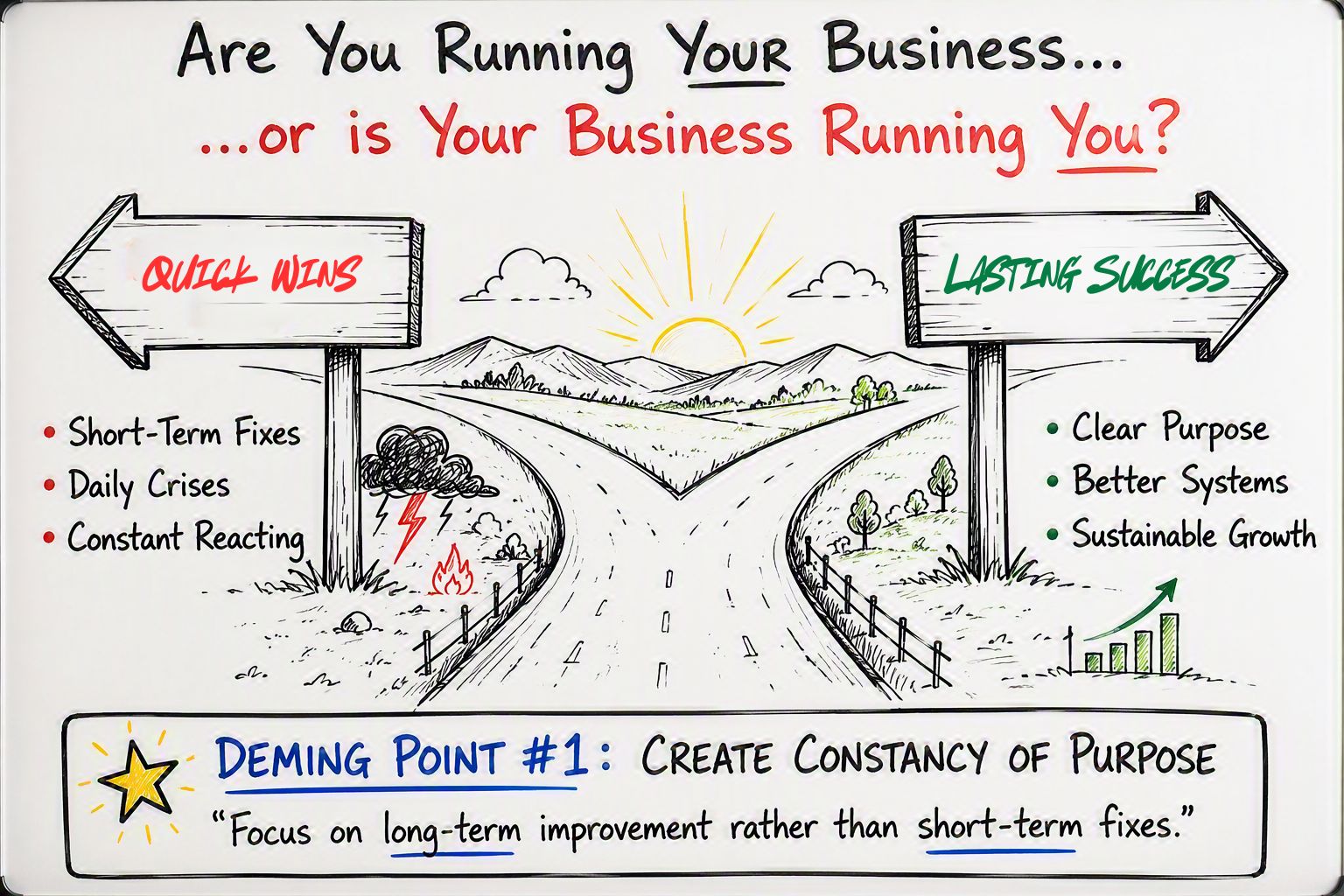
Create Constancy of Purpose: Deming's First Point for Lasting Business Success
If you own or lead a small business, it can feel like every day is a new fire to put out.
- A customer issue
- An employee problem
- A late shipment
- A cash flow challenge
- A machine breakdown
- A software problem
I've seen many business owners spend so much time reacting to today's problems that they never have the opportunity to build tomorrow's business.
This is why I believe Deming's first point is arguably the most important of all 14:
"Create constancy of purpose toward improvement of product and service."
At its core, Deming was teaching leaders to think beyond today's crisis and make decisions based on where they want their company to be years from now, not just next week.
Many people assume Deming's ideas only apply to large manufacturers.
I disagree.
In fact, small businesses may benefit even more.
When you have 5, 10, 20, or 50 employees, every decision matters. Every hire matters. Every customer matters. You don't have the luxury of wasting resources chasing conflicting priorities.
What Constancy of Purpose Looks Like
A Business Without Constancy of Purpose
Businesses that lack a clear long-term purpose often:
- ❌ Chase every opportunity
- ❌ Constantly change priorities
- ❌ Focus only on short-term revenue
- ❌ Start improvement projects and abandon them
- ❌ React more than they plan
A Business With Constancy of Purpose
Organizations that maintain a clear purpose tend to:
- ✅ Invest in people
- ✅ Improve systems
- ✅ Focus on customer value
- ✅ Make decisions aligned with a clear vision
- ✅ Build sustainable growth over time
Deming warned that organizations frequently become trapped by short-term thinking and lose sight of their long-term mission.
A Real-World Example
One reason Toyota is frequently associated with Deming's teachings is its commitment to long-term thinking.
Toyota's first principle emphasizes making management decisions based on a long-term philosophy, even when short-term financial results might suggest a different path.
Over decades, that approach helped Toyota build a reputation for:
- Quality
- Reliability
- Continuous improvement
- Customer trust
The lesson for small businesses isn't "be like Toyota."
The lesson is that successful organizations consistently align decisions with a long-term purpose instead of constantly changing direction.
How Small Business Leaders Can Apply This Today
Here are five practical actions you can take.
1. Define Your North Star
Ask yourself:
What do we want to be known for five years from now?
Not next quarter.
Not this month.
Five years.
Write the answer down.
Share it.
Repeat it often.
2. Evaluate Every Major Decision Against That Purpose
Before making a significant change, ask:
Does this move us closer to our long-term purpose?
If the answer is no, reconsider it.
A clear purpose becomes a filter for decision-making.
3. Invest in Improvement Even When You're Busy
The busiest organizations often need improvement the most.
Set aside dedicated time each month to improve processes instead of only reacting to problems.
Improvement should not be an occasional activity. It should be part of how the business operates.
4. Invest in People
Training, coaching, and development are long-term investments.
Deming believed organizations should continually improve their ability to serve customers by helping employees develop new skills and capabilities.
The organizations that grow consistently are often the organizations that develop their people consistently.
5. Measure More Than Financial Results
Revenue matters.
Profit matters.
But business leaders should also monitor leading indicators such as:
- Customer satisfaction
- On-time delivery
- Process quality
- Employee development
- Improvement implementation
These metrics often provide early warnings and opportunities long before financial results reveal a problem.
Why This Matters More Than Ever
Many organizations spend years reacting to problems while making little progress toward a larger vision.
Without constancy of purpose, teams become overwhelmed by shifting priorities and competing initiatives.
With constancy of purpose, decisions become clearer, resources are used more effectively, and improvement efforts compound over time.
Purpose provides direction.
Improvement provides momentum.
Together, they create sustainable growth.
Final Thought
Many business owners work incredibly hard.
The question is whether that effort is building something intentional.
The businesses that achieve lasting success aren't always the ones that work the hardest.
They're often the ones with the clearest purpose.
Deming's first point reminds us that improvement is not something we do when we have time.
Improvement is the work.
Key Takeaways
- Constancy of purpose helps organizations focus on long-term success rather than short-term reactions.
- Small businesses benefit greatly from aligning decisions with a clear vision.
- Sustainable growth requires investment in people, systems, and continuous improvement.
- Leading indicators often provide better insight into future success than financial results alone.
- Improvement should be an ongoing practice, not an occasional project.